Saturday, December 8, 2012

Uptown Theatre, 4816 N. Broadway, Chicago, IL


Seating 4300
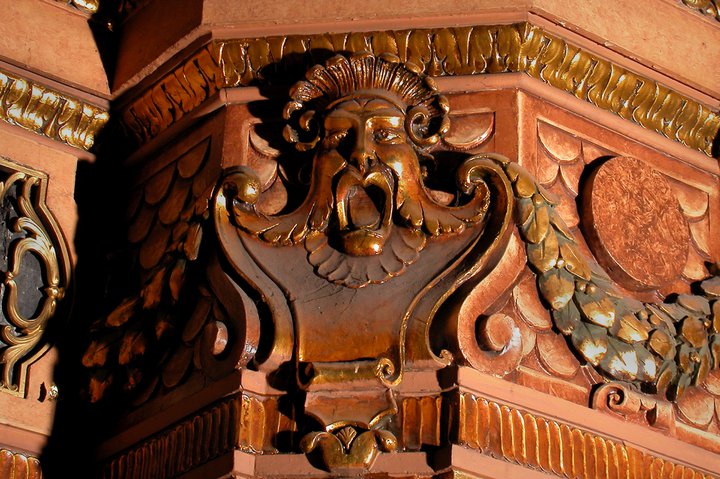
The Uptown Theatre, also known as the Balaban and Katz Uptown Theatre, is a massive, ornate movie palace in the Uptown neighborhood of Chicago, Illinois.

Designed by Rapp and Rapp, it was constructed in 1925 for the Balaban and Katz theater chain.
The largest in Chicago, it boasts 4,381 seats and its interior volume is said to be larger than any other movie palace in the United States, including Radio City Music Hall in New York. It occupies over 46,000 square feet (4,300 m2) of land at the corner of Lawrence Avenue and Broadway in Chicago's Uptown Entertainment District. The mammoth theater has an ornate five story entrance lobby with an eight story façade.

When the Uptown opened in August 18, 1925, the phrase "an acre of seats in a magic city" was coined to describe the wonders of over 4,300 seats in a theater that covered 46,000 square feet of land. At the time, it was the third largest in terms of seating. But it was the largest, by far, in land area and cubic volume, due in part to the three vast lobby areas. The Grand Opening of the Uptown Theatre was accompanied by a "Central Uptown Parade" of over 200 floats and a grand ball at Harmon's Arcadia in Uptown. Over 12,000 people stood in line to be ticketholders in the very first audience. Several women collapsed because of exhaustion.


Literature encouraged patrons to "come for the most awe-inspiring sight of your life." The Grand Opening of the Uptown Theatre was accompanied by a "Central Uptown Parade" of over 200 floats and a grand ball at Harmon's Arcadia in Uptown. Over 12,000 people stood in line to be ticketholders in the very first audience. Several women collapsed because of exhaustion.

Uptown Theatre staff and stage shows
The theater opened with a staff of over 130 people, including a full time 34 piece orchestra, a nurse, firemen and others. Elaborate stage show productions would accompany each movie, unique in that the elaborate stage shows would follow the theme of the movie.


Many of the details we associate with a movie palace had not been codified by the time the Uptown opened. The stage shows were planned in consideration of the feature. Music was customized for the large orchestra, as well as for the Uptown's Wurlitzer organ, the second largest one in operation. Stars of national fame played regularly. Even the posters in the display cases were custom artwork with new items every week.

By the end of the 1920s, after more than 20 million people had already attended the Uptown. Some of the greatest theaters, such as Radio City Music Hall in New York, were not even on the drawing boards yet.

Initially, sound film and depression economics did not affect the Uptown, because of the uniqueness and quality of the entertainment, and the competition that had been eliminated through the policies of Balaban and Katz. Eventually, with the availability of 1930s musicals and the like, film became the mainstay. The stage was used only on rare occasions through the 1940s. By the end of the decade, Balaban and Katz reinstituted their traveling shows, booking first the Chicago and then traveling weekly to the Uptown in the north, the Marbro in the west, and the Tivoli in the south. This system proved unsuccessful. Competing distractions such as radio and television, and an increase in the number of working housewives limited both evening and matinee audiences.

Thereafter, through the 1950s and early 1960s, film fare became the mainstay again with occasional use of the stage for rentals.
1951 Nuns at the Uptown.
The most notable rented use of the stage was for the television show "Queen for a Day," which televised one week every year in the theater. The Uptown was also used as a large hall, especially for corporate meetings, such as those held here by Standard Oil of New Jersey. These uses created revenue. But later, with declining film revenue, furnishings were sold on occasion, starting with the organ in 1962. Soon, because of high insurance costs and vandalism, all extraneous artwork was sold, including more than 90 major oil paintings and 18 major marble groups. These sales yielded several million dollars.
Born Harry Broughton, Harry Blackstone (September 27, 1885 November 16, 1965) was a famed stage magician and illusionist of the 20th century. He began his career as a magician in his teens and was popular through World War II as a USO entertainer. He was often billed as The Great Blackstone.
$42,000 week December 26th to January 1st
121,833 people witnessed his performance.
Harry Blackstone was in the mode of courtly elegant predecessor magicians like Howard Thurston and Harry Kellar. He often wore white tie and tails when performing, and he traveled with large illusions and a sizable cast of uniformed male and female assistants. For a number of years he toured in the Midwest, often performing throughout the day between film showings.
Blackstone remained silent during much of his big stage show, which was presented to the accompaniment of a pit orchestra and such lively tunes of the time as "Who", "I Know That You Know", and "Chinatown."
Among his especially effective illusions was one in which a woman lying on a couch and covered with a gossamer shroud appeared to float high in the air and then vanish, as Blackstone pulled off the covering. In another illusion, a woman stepped into a cabinet in front of many bright, clear, tubular incandescent light bulbs. When the magician suddenly pushed the perforated front of the cabinet backward the light bulbs protruded through the holes in the front of the box (to the accompaniment of the lady's blood-curdling scream). The cabinet was then revolved so that the audience seemed to see the lady impaled by the blinding filaments.
His "Sawing a woman in half" involved an electric circular saw some three to four feet in diameter mounted on a swing-down arm. Blackstone demonstrated the efficacy of the device by sawing noisily through a piece of lumber. Then a female assistant was placed on the saw table in full view, as wide metal restraints were clamped upon her mid-section. The blade whirred and appeared to pass through her body, as ripping sounds were heard, the woman shrieked, and particles were scattered by the whirring blade. When the blade stopped she, of course, rose unharmed. [3]
Blackstone spent the last years of his life performing at The Magic Castle, a magical attraction in Hollywood, California. He died in November 1965 at the age of 80.
In 1985, on the 100th anniversary of his father's birth, Harry Blackstone, Jr. donated to the Smithsonian Institution in Washington D.C. the original floating light bulb - Thomas Edison designed and built it - and the original Casadega Cabinet, used in the "Dancing Handkerchief" illusion. This was the first ever donation accepted by the Smithsonian in the field of magic.[5]

In the early 1970's, a campaign of interested volunteers petitioned the corporate successor to Balaban and Katz to investigate other uses for the theater beyond just movies. This was an attempt to ensure sufficient revenue and interest was generated to maintain the viability of the structure. At this time, various rock concert promoters were booked occasionally to great success and profit. Bands such as ELO and the Grateful Dead performed at the theater.

However, with deferred maintenance in the 1960s and 1970s, when revenues were failing, the building at more than 50 years had reached a point of much-needed repairs. Rather than manage the building, it was marketed, sold, and reverted back to the successor, Plitt Theatres. With no ability to manage such a complex facility, Plitt boarded up the building and awaited further ideas.

Most of the damage to the building occurred in the early 1980s, making it unusable without restoration.
The Uptown Theatre has been closed to regular events since the winter of 1981 when, due to the owner having turned off the heat, a frozen water pipe burst and caused extensive damage to the interior. In subsequent years, deferred maintenance and vandalism have led to further debilitation of the structure and ornament, both inside and out. Subsequently, even with the assistance primarily of volunteers, the building remained in the hands of a notorious tax-sale buyer and continued to deteriorate. During this time volunteers managed to have the theater designated a Chicago Landmark and recorded on the National Register of Historic Places.


Because of yet another tax sale and further mismanagement, the building now has reached the hands of a management company very aware of how much of a jewel the building is. The owner is interested in renovation and possible restoration of the theatre so it can serve again some large entertainment use.

Rehabilitation efforts are needed to restore and reopen this historic Chicago landmark,[2] which has been closed to regular audiences since 1981.
Photo by Jay Blakesburg
In 2006, the exterior was extensively secured and terra cotta pieces were cataloged and stored for future restoration efforts.
A May 21, 2007 article in Crain's Chicago Business described the Uptown Theatre as "suddenly a hot property," as three national entertainment companies were in competition to purchase, restore and reopen the Uptown Theatre.[2]
On July 29, 2008, Chicago-based Jam Productions bought the historic Uptown Theatre at a forced judicial sale, but it says tens of millions of dollars are needed to reopen the venerable entertainment venue.

Jam said after the sale that the long-suffering theater won't reopen without a major infusion of public money.

"Buying the Uptown is one thing, rehabbing it is another," said Jam principal Jerry Mickelson, whose UTII entity paid $3.2 million for the theater, at 4814 N. Broadway. "This will have to be a partnership between the city, the state and ourselves."

Mickelson said he expects restoration to cost between $30 million and $40 million. "No private entity could afford to put that amount of money into a theater," he said. "The Uptown can only reopen with the necessary funding from the city."

By Mark Caro Tribune reporter
The front doors are boarded up in shades of gray and beige, while the weathered marquee, propped up by four poles anchored near the street, displays empty light-bulb sockets and the rusty white letters out front spelling “UPTOWN.” Stragglers in this diverse, ever-struggling neighborhood might lean against the boards for a smoke or cellphone chat, but nothing's going on here. Hasn't been, really, for almost 30 years.
Here's a classic photo of urban blight.
Here's the crumpled paper wrapping around a diamond.
Remove the padlocks from the makeshift wooden doors, step through the entryway into Uptown Theatre's main lobby, however, and you're in gasp city. What you see makes the Chicago Theatre's grand entrance look like a guesthouse foyer.
"Your jaw drops," said Mayor Rahm Emanuel, whose support for this crumbling, 86-year-old theater has triggered renewed hopes for a revitalized Uptown neighborhood. "It's stunning."
The space is big enough for Chicago Bears scrimmages and elegant enough for a royal ball. The almost pristine gray and black marble floor leads to a pair of curved, majestic, red-carpeted staircases and is flanked by ornate pillars, figurines, grates, gargoyles, carvings, frescoes and other ornamentations so intricate and beautifully rendered that it would take weeks to admire them all. One floor-to-ceiling slice of column and wall shines brighter than the others, its 24-carat gold and silver leaf designs restored 20 years ago to show how this jewel used to gleam.
That's just the main lobby. Pass through numerous other spaces, all designed contrastingly and painstakingly, and eventually you reach the Uptown Theatre's sprawling, gracefully raked, dramatically domed auditorium, which boasts what was billed on the theater's 1925 opening-night marquee as "an acre of seats in a magic city."
Jerry Mickelson said he has been in awe of this place since he first passed through its doors in 1974. On Oct. 31, 1975, his company, Jam Productions, produced its first concert there: the Tubes. On Dec. 19, 1981, it produced the Uptown's last show: the J. Geils Band.
"There was no heat," the 60-year-old promoter recalled. "The bathrooms were barely functioning. Things were starting to deteriorate then, and that's when I said to the owner, 'You can't open this anymore.' Because he hadn't put money in it. So we said, 'We're out. You've got to close it.'"
Almost 30 years later, the Uptown Theatre remains shuttered, an oversized symbol of the teasing promise and ongoing dilapidation of the Uptown neighborhood. Every few years there's a flurry of talk about restoring the theater and giving the neighborhood back its long-ago bustle — all while those wooden planks outside keep serving as a barrier between the public and its magnificent lobby.
Yet despite a continued economic downturn that has dried up public and private funding sources, a newfound sense of optimism is gathering around the prospect of eventually reopening Uptown Theatre as an anchor to an Uptown entertainment district. Mickelson has been pushing for such a development since he and his Jam partner Arny Granat (and their spinoff company, UTA II) bought the theater out of bankruptcy in 2008 for a reported $3.2 million, but Emanuel has moved the issue to the front burner with his recent declarations of support for a music hub in the neighborhood.
"It can happen now because people are finally seeing the intertwined connection between culture and economic development," the mayor said in an interview Monday.
The two new aldermen who represent the quirkily divided neighborhood — Harry Osterman of the 48th Ward (which includes the Uptown Theatre and Green Mill Jazz Club a few doors south) and James Cappleman of the 46th (which includes the nearby Riviera Theatre and Aragon Ballroom) — are encouraging the effort, as are various city departments. Mickelson also recently signed on Phil Tagami, an Oakland-based developer who spearheaded the pricey but neighborhood-transforming restoration of that city's historic Fox Theater, as a consultant. Tagami is in town this week for meetings with Mickelson, the aldermen, city officials and community representatives.
"It's like the stars are all in alignment," said Michelle Boone, the city's Cultural Affairs and Special Events commissioner.
Of course, the stars are one thing. Money is another. Mickelson's estimated price tag for restoring the Uptown to its former glory?
$70 million.
"There's going to be some problems with that," said Danny Bell, a retired Chicago History Museum security guard waiting for the bus at Lawrence Avenue and Broadway last week, laughing upon hearing the figure. "I don't think there's $70 million in cash in the whole country."
But, Mickelson likes to point out, the Uptown's architects created it "not for today but for all time," and he intends to renew that promise.
"Just look at this building," Mickelson said as he stood in the balcony inside the arching front window with a panoramic view of the lobby and a city block's worth of theater. "We can't lose this thing. You'll never see something like this again."
Decline of a true original
The Balaban & Katz company already was operating such movie palaces as the Loop's Chicago Theatre, the South Side's Tivoli, the West Side's Central Park and the North Side's Riviera when it set out to build its most lavish theater yet. The Uptown, like those other venues, was designed by the renowned architecture firm Rapp and Rapp, which aimed to top itself in designing a theater that, at 46,000 square feet was thought to be the country's largest-ever traditional movie palace.
Others, such as Radio City Music Hall, surpassed Uptown's 4,381 seats, but the Uptown building is like a little city. The multiple lobbies could hold the auditorium's entire capacity, so, current Uptown caretaker Dave Syfczak said, the theater could completely turn over the house between shows in a mere 16 minutes.
Part of the building — Spanish Baroque with other influences incorporated in different spaces — was constructed on what had been the outdoor gardens of the Green Mill, which opened in 1907. At the time, silent movie presentations often were accompanied by live stage shows, and Balaban & Katz was seeking to elevate the theater experience beyond vaudeville, through the lobbies' luxurious details and fine-art displays, as well as the vast auditorium and stage.
"The Chicago Theatre downtown has a proscenium opening that's 70 feet wide," said Syfczak, a Chicago police officer who has been voluntarily caring for the Uptown since 1996. "When they built this building, they wanted their ad copy to say 'the widest stage in Chicago,' so they had Rapp and Rapp design the stage proscenium opening 70 feet and 1 inch."
For decades the theater and neighborhood thrived, with the Uptown presenting movies and shows and hosting such events as Standard Oil of New Jersey shareholder meetings and live broadcasts of the TV game show "Queen for a Day."
"This intersection was like Times Square," Syfczak said. "You had the Aragon Ballroom across the street, the Riviera Theatre, this place operating, a lot of (other) clubs; there was a lot of activity in this neighborhood. But when the neighborhood declined in the late '60s and early '70s, it of course contributed to the decline of the theater also."
The Uptown had been showing second-run movies when Jam began booking rock shows there. The list of performers is impressive: The Grateful Dead for six three-night stands between 1978 and 1981; Bruce Springsteen and the E Street Band for three shows in 1978 and 1980; Bob Marley and the Wailers for dates in 1976, 1978 and 1979; Frank Zappa for four visits (and five shows) between 1977 and 1981; Cheap Trick opening for the Kinks in 1977; Genesis and Peter Gabriel playing six days apart in October 1978; and Prince opening for Rick James in early 1980 and headlining later that year.
Even now, one of the well-worn seat backs in the dusty auditorium boasts a Grateful Dead bumper sticker that reads, "Warning, I Brake for Hallucinations." In the oval ladies lounge, these words remain scrawled: "Springsteen is God."
But the rock bookings and movie screenings couldn't keep the theater — owned by the Plitt movie theater chain and, for much of Jam's time there, a local theater operator named Rene Rabiela — from falling into disrepair and eventual insolvency. The heat was shut off, and in winter 1982 the pipes burst, flooding the basement and causing extensive damage to ceilings, walls and staircases that has yet to be repaired.
"There was a glacier of ice coming down this grand staircase that was about 14-18 inches thick," said Jimmy Wiggins, Jam's venue operations manager overseeing the Riviera, Vic and Uptown. In the lower-level men's lounge, with its Knights of the Round Table feel, Wiggins pointed to a waist-level line on the wall. "This is how much water sat in this building for over a year."
Since that final 1981 concert, the Uptown has passed through a multitude of owners, some more savory than others, who couldn't get it running again, all while volunteer groups such as Friends of the Uptown fought to stave off the wrecking ball. Parts of Ron Howard's 1991 firefighter movie "Backdraft" and the 1994 Julia Roberts/Nick Nolte comedy "I Love Trouble" were filmed there, and the main lobby doubled as the FAO Schwarz-like toy store in the John Hughes/Chris Columbus sequel "Home Alone 2: Lost in New York" (1992). Syfczak said a wedding took place in the lobby years ago as well, though the building no longer is fit for such events.
Wiggins said when he checked in on the building during the winter of 1993-1994, he came upon a startling sight: "There were homeless people building fires on the grand floor there, on the marble floor, and they had broken these grates up with sledgehammers and were carting them off for scrap money."
At another point, Syfczak discovered that a tower of pigeon dung had accumulated inside the broken front window, and as he jammed his shovel into the pile, mice scattered from within. The since-repaired window now is covered by a large curtain taken from the stage.
Steps have been taken to stem the deterioration and to preserve what's there. Several years ago chunks of the glazed terra cotta facade were removed, cataloged and stored inside the building, and Mickelson said he and Granat have been putting six figures (he wouldn't say high or low) into the place annually to keep it repaired, heated, cooled and at proper moisture levels.
But that's all just maintenance. Mickelson's plans go far beyond that.
2 needs: Time and money
In 2000, the Urban Land Institute, a Washington, D.C.-based nonprofit research and education organization, issued a 48-page advisory report on how to transform the Uptown Entertainment District. The recommendations are as specific as what new street lamps should look like, but the broader stroke is that Uptown Theatre is the area's "crown jewel" and "one of the most outstanding theaters in the United States … a major historic and aesthetic treasure that must be maintained."
The economic picture has changed since the institute's report, but an Uptown neighborhood flush with new development and activities remains the vision being chased by Mickelson and the city.
"This could make the Uptown area a great entertainment district that could drive the economy of that area with more restaurants and more other types of retail and commercial life that would really take off," Emanuel said, citing the Old Town School of Folk Music's impact on Lincoln Square.
Mickelson and Granat hired the local architecture firm Booth Hansen, which restored the Loop's Bank of America Theatre (formerly known as the LaSalle Bank Theatre, the Shubert and the Majestic), to draw up a feasibility study, which was issued in fall 2009. The firm presented three options, ranging from a plan that would make the building merely operational again (about $55 million) to one that would restore the theater completely ($70.8 million).
"You can go in and fix the structural problems — make the exiting work, put in more bathrooms — and it will be functional," Booth Hansen principal/director George Halik said. "I think the real challenge is to get enough support and money to make it a real jewel, which it is, and not just a big space."
Due largely to the water damage, Halik said, the Uptown is in worse shape than the much smaller Shubert/Bank of America Theatre building was before its reported $14 million renovation. But Tagami, the Oakland-based developer, said he was surprised to see how well-preserved the Uptown was when he first visited. Tagami had told Mickelson he wouldn't take on this project unless he fell in love with the building.
"It's an amazing building with a great history and a great story, and quite frankly it's in a wonderful community," Tagami said. "You can't spend enough time there. I'm used to seeing historic structures that are in far worse condition. The building has very good bones."
Still, a ton of money must be raised from sources both private (corporate naming rights are being discussed) and public. Tagami said Oakland's Fox Theater project, which included an addition built for a new performing-arts school, drew its almost-$90 million budget from more than 20 sources. Now he and Mickelson are trying to line up a network of potential incentives and programs to help finance the Uptown, including city tax increment financing, federal new market tax credits (to spur investments in low-income communities) and historic preservation tax incentives (rebates for work on buildings listed on the National Register of Historic Places, which the Uptown is).
Emanuel said the developers shouldn't count on getting most of their funding from the public realm. "It has to be mostly private because that's going to be where a lot of the gain's going to be, and that's how it should be," he said. "But I'm pushing it as a champion for it."
Given that commercial entities such as Jam also don't tend to be at the center of large fundraising campaigns, Mickelson said one possibility is the creation of a not-for-profit entity that might take over the theater's operations while Jam booked the acts. What's most important, Mickelson said, is to get the place open again. Ric Addy, owner of the used books and records store Shake, Rattle & Read next door, said a restored Uptown would cement the veteran promoter's legacy.
"This would be the jewel in his crown if he could make it happen," he said.

He'd like to remove the floor-level seats and tier the main floor a la the Riviera, raising the capacity to about 5,000. Rene Rabiela Jr., who tried to spearhead a restoration effort before Mickelson took over — and whose father previously owned the Uptown— said he's rooting for Mickelson but would prefer to see the seats maintained.
With the largest outdoor amphitheaters and arenas struggling in the current rock concert climate, Mickelson said he could see booking 80-100 shows a year at the Uptown. To what extent such bookings might take business from other theaters remains an open question, though Mickelson said the Uptown would attract different types of shows than the all-general-admission Aragon, with its capacity of 4,900.
"We want to maximize the performances and performing opportunities citywide," said Marj Halperin, a communications and strategic management consultant as well as vice chair of the mayor's advisory council on arts and culture. "We don't want to just transfer them from one venue to another."
Still, Halperin stressed, "I think there isn't anyone involved in this who doesn't want it to happen."
'Energy sure feels different'
Boone emphasized that the city and developers still need significant input from the community. But at this point the most common negative sentiment seems to be skepticism.
"I'll believe it when I see it," Green Mill owner Dave Jemilo said. "They've been talking about it for 25 years. … It's a hard thing these days to make any dough with something that size. It's going to be millions and millions and millions of dollars to get it up and going, and you've got to make that money back somehow. But if it can happen, I'm all for it. The more the merrier, man."
StoryStudio Chicago director Jill Pollack counted herself among those Uptown residents disappointed that years of talk about the theater hasn't yielded results, but now, she said, "the energy sure feels different."
Now residing on the same block as the Uptown are the Annoyance Theatre, the upscale Indian restaurant Marigold, the popular gay sports bar/grill Crew, the recently arrived Middle Eastern restaurant Caravan, a high-end home-theater store plus Shake, Rattle & Read and the Green Mill. The Black Ensemble Theater is set to move into its new $19 million home at the southwest edge of the neighborhood next month, and the busy year-old Target store a half-mile south of the Uptown on Broadway has spurred hopes that the vacant storefronts in between may someday be filled.
"People are walking up and down Broadway again, and with Mayor Emanuel talking about Uptown becoming an arts district, what's not to be excited about?" Pollack said.
The public will have a rare opportunity to step into the Uptown Theatre as part of an Oct. 26 fundraiser for Uptown United, the area's business-boosting organization. A $100 ticket buys cocktails in the Bridgeview Bank rotunda, dinner at an Argyle Street restaurant and a tour of the Uptown Theatre lobby.
Boone said when she recently set foot inside the building for the first time, she was blown away by how misleading that shabby exterior is.
"When you walk into the lobby, it's so majestic," she said. "It's a beautiful, beautiful space, and I can't wait to go to the first concert when they reopen the doors."
She added: "It'll happen."(1)

1/30/78 Grateful Dead
1/31/78 Grateful Dead
2/1/78 Grateful Dead
5/16/78 Grateful Dead
5/17/78 Grateful Dead
5/18/78 Grateful Dead
11/16/78 Grateful Dead
11/17/78 Grateful Dead
11/18/78 Grateful Dead
 5/13/79 Grateful Dead
12/3/79 Grateful Dead
12/4/79 Grateful Dead
12/5/79 Grateful Dead
5/11/80 Grateful Dead
8/19/80 Grateful Dead
8/20/80 Grateful Dead
8/21/80 Grateful Dead
2/26/81 Grateful Dead
2/27/81 Grateful Dead
2/28/81 Grateful Dead
11/17/81 Jerry Garcia Band (Uptown's last show was the J. Geils Band on Dec. 19, 1981)
9/17/82 Grateful Dead
10/18/83 Grateful Dead
3/31/85 Grateful Dead
4/1/85 Grateful Dead
3/27/86 Grateful Dead
3/28/86 Grateful Dead

1.)^Griffin, Mary (April 25, 2002). "Civic Center Opens In 1977 And Has Never Looked Bad". Bangor Daily News.
1.)^Caro, Mark, Uptown Theatre: Polishing an old jewel, 2011-10-11, Chicago Tribune, http://articles.chicagotribune.com/2011-10-11/entertainment/ct-ent-1012-focus-uptown-rehab-20111011_1_uptown-theatre-uptown-neighborhood-jewel/4
2.)^Baeb, Eddie (2008-05-21). "Uptown Theatre draws crowd of suitors". Crain's Chicago Business, http://en.wikipedia.org/wiki/Uptown_Theatre_%28Chicago%29
3.)^ http://www.youtube.com/watch?v=IdeGOBkJoMM&feature=youtu.be Harry Blackstone, Sr. performing the sawing a woman in half illusion in 1934, film from Youtube
4.)^Weatherford, Mike. "Award too late to help magician Hans Klok". Las Vegas Review-Journal.
5.)^Harry Blackstone Jr. donates Harry Blackstone Sr. illusions to Smithsonian, http://www.amdest.com/stars/harryb.html 

Friday, December 7, 2012

Cinnamon Tree, 900 American Street (Way) , San Carlos, CA 94070

The Cinnamon Tree was in an industrial area with roll up doors and had a cement floor. And it had been converted to a teen club.(2)
The Cinnamon Tree opened in July 1965 as a "teen" club, with no liquor served (though no doubt plenty was consumed). The idea was to give teenagers something to do, particularly on weekends. The club was located on an industrial road between El Camino and the Bayshore Freeway. Since it featured teen audiences, one of the popular bills was a "Battle Of The Bands" were numerous groups played a song or two, hoping to win a cash prize (thus insuring that each band's friends came to the show). (1)
In 2012 a business, Lino Valbusa, is at this location.

8/65 Warlocks
"When I was playing guitar in William Penn & His Pals in 1965-66 a battle of the bands was a frequent thing. There was a club owned by an ex-cop called the Cinnamon Tree in San Carlos that sponsored these events. The audience were aged 12 to 17 about 100 or so. They were all sucking down cokes and eating cookies. At one of these battles we went head to head with The Warlocks. You couldn’t have gotten a more odd combination of combatants. We were dressed like Paul Revere in our tri-cornered hats and The Warlocks were the most wildest assortment of characters you could find.  The Warlocks lineup was Jerry Garcia, Pig Pen, Dana Morgan Jr. on bass, Bill Kreutzman and Bob Weir. The William Penn lineup was Mike Shapiro on lead guitar, Jack Shelton on rhythm guitar, Gregg Rolie on keyboards, Steve Leidenthal on bass, Ron Cox on drums.The Warlocks played a set, William Penn played a set and the crowd judged in favor of the Warlocks. It made no sense to me at all. William Penn played radio hits and the Warlocks played blues jams and made other weird sounds. Jerry understood the English sound but didn’t copy it like we did and the audience responded."(2)

"...and for a short time, the lineup also included a second drummer, Mickey Hart.(3)

1.)^The Illustrated Trip, places, Warlocks gig(s) at The Cinnamon Tree in August.
2.)^Shapiro, Mike, guitarist.
3.)^http://www.allmusic.com/artist/william-penn-and-his-pals-mn0001320652

Thursday, December 6, 2012

Veteran's Memorial Auditorium, 1094 Petaluma Blvd. S., Petaluma, CA


Capacity 900


2/15/87  Carlos Santana and Hamza Al-Din

Veteran's Memorial Auditorium, 1351 Maple Avenue, Santa Rosa, CA


Capacity 1200
Just across Highway 12 from the Sonoma County Fairgrounds this building contains the Auditorium, dining room, Lodge room, North Room,Judge's Chamber, and Conference Room.

6/17/66 Grateful Dead (Thunder Machine Production)
6/18/66 Grateful Dead (Thunder Machine Production)
6/27/69 Grateful Dead and Cleanliness and Godliness Skiffle Band
6/28/69 Grateful Dead
"The first night (June 27), after CGSB and Hot Tuna (Jorma, Jack, Joey) had played their sets, Mickey Hart had not yet arrived. It might seem that the Dead would be unconcerned, since Bill Kreutzmann can hold down the drum chair quite well on his own. For whatever reason, the Dead invited CGSB drummer Tom Ralston to sit in with the band until Hart arrived. Ralston was originally from Michigan (where he was in a band called The Renegades), had migrated to Berkeley and played with the group Sky Blue before joining CGSB, and he later played with Country Joe McDonald for some time.
Although an accomplished drummer, Ralston was quite surprised to be asked to sit in with the Dead with no preparation. Hart arrived after a few numbers, but it was a memorable night for the Cleanliness and Godliness Skiffle Band. Since so many Dead tapes are accessible, you can decide for yourself what you think of Ralston’s drumming—he certainly doesn’t embarrass himself. No one precisely recalls when Hart arrived and stepped in, but it was certainly before “Dire Wolf” (the 8th song of the first set) which was later released on an archival cd."(1)

Grateful Dead, Jorma Kaukonen, Jack Casady, Joey Covington, Cleanliness and Godliness Skiffle Band.
Jerry Garcia played pedal steel guitar with CGSB during one of these shows, probably the first night. Kaukonen and Casady were not yet calling themselves Hot Tuna. On the first night, Mickey Hart had not arrived at the show on time, and Tom Ralston joined Bill Kreutzmann in drumming for the Dead for the first few numbers. One song from June 27, 1969 (“Dire Wolf”, with Bob Weir on lead vocals and Jerry Garcia on pedal steel) was even released by the Dead, on the 2003 CD re-release, but it is unclear if Ralston actually played on it. Since it appears to be the 8th number in the set, foggy memories suggest that Hart had arrived and retaken his drum chair by this time. At the time, Jerry Garcia had just purchased his pedal steel guitar and was just beginning to work with John “Marmaduke” Dawson and David Nelson on the band that would become the New Riders of The Purple Sage. During Grateful Dead sets, Garcia played pedal steel guitar on a few numbers with the Dead, but he was clearly looking for new opportunities to test his chops, and thus he offered to sit in.

Brian Voorheis doesn’t recall the precise set list, but he does remember the country styled songs they were playing, some of which Jerry would have sat in on:
Who Will Buy The Wine (from Skiffle album), A-11 (a Buck Owens tune about a jukebox selection that makes him cry ), How High's The Water, Mama? (a Johnny Cash classic sung by Gary), County Fair (a Gary Salzman original ),and I may have done Johnny Cash's There You Go - can't remember if I was doin it yet. There could also have been Gary's other originals, (It's Hard To Keep Your Head Above The) Waterline, and I Couldn't Marry Juana (Cause I Couldn't Get Her Out Of Mexico).

1.)^SonomaPicMan, http://www.flickr.com/photos/sonomapicman/6953240580/

Tuesday, December 4, 2012

Marin Veteran's Memorial Auditorium, Marin Civic Center, 10 Avenue of the Flags, San Rafael, CA

The 140-acre (0.57 km2) Scettrini Ranch in Santa Venetia was purchased in 1956 for $551,416 for use as the site of the Civic Center and County Fairgrounds.
Frank Lloyd Wright presenting the Civic Center plans at San Rafael High School, March 25, 1958. Image from the cover of This Week In Marvelous Marin, December 26, 1958.
On July 31, 1957, Frank Lloyd Wright spoke at a public meeting at San Rafael High School to impart his philosophy of architecture and particularly, organic architecture. Following that meeting, he signed the contract that made him the official architect for the Marin County Civic Center and fairgrounds complex. The next day, he was driven to the Scettrini Ranch, site of the new Civic Center, and announced that he had come up with his design.

A year later, on March 25, 1958, Wright returned to San Rafael High School with a complete set of drawings for the entire site, including the Administration Building, Hall of Justice, Veterans' Memorial Auditorium, and numerous buildings and structures for the fairgrounds. It was an informal session with opportunities for community members to ask Frank Lloyd Wright questions.

How would you characterize your project for the Marin County Civic Center?
Here's his answer: http://www.marinlibrary.org/sites/default/files/FLW%20excerpt%203.mp3

Groundbreaking for the Civic Center Administration Building took place in 1960, after Wright's death, and under the watch of Wright's protégé, Aaron Green, and was completed in 1962.
The Hall of Justice was begun in 1966 and completed in 1969. This was the last commission by Frank Lloyd Wright.


Veterans Memorial Auditorium opened in 1971 by Taliesin Associates (senior architect: William Wesley Peters and Associate, Aaron Green) , and the Exhibit Hall opened in 1976.
The auditorium was completed about fifteen years after the first commission was accepted. The Auditorium, however, echoes details of the neighboring Civic Center, especially in its curvilinear forms and the roof design.

Photos courtesy of Mary Sullivan
The Marin County Civic Center is a state and National Historic Landmark.[2] The Civic Center has been nominated for the UNESCO World Heritage List[4] as a part of ten properties by Frank Lloyd Wright.

The Civic Center Tower is the tallest artificial structure in Marin County.
On August 21, 1975 the Symbionese Liberation Army planted bombs in the Civic Center parking lot, which detonated and destroyed two sheriff's cruisers. Black Panther activist Angela Davis was eventually tied to the case, prompting her to go on the run before being caught and ultimately acquitted on charges of supplying firearms to the S.L.A.

The original design called for the roof to be gold in color, but was changed to blue in 1961.

The Civic Center has been referred to as the "Martian Embassy" due to the futuristic appearance of the spire and "flying saucer" at the south end of the building.

6/2/73 Merl Saunders
2/18/78 Jerry Garcia Band
10/30/83 Grateful Dead
10/31/83 Grateful Dead
3/28/84 Grateful Dead
3/29/84 Grateful Dead
3/31/84 Grateful Dead
4/1/84 Grateful Dead
9/29/84 John Kahn (acoustic)
2/28/86 John Kahn (acoustic)
11/14/86 John Kahn (acoustic)
2/20/87 Jerry Garcia Band
4/26/88 Jerry Garcia Acoustic Band

Sources on Marin Civic Center
Bruce Pfeiffer. Frank Lloyd Wright Drawings. New York: Harry N. Abrams, Publishers, 1990. aerial perspective drawing, p169.

Bruce Brooks Pfeiffer and Gerald Nordland, ed. Frank Lloyd Wright: In the Realm of Ideas. Carbondale and Edwardsville: Southern Illinois University Press, 1987. ISBN 0-8-93-1421-5. LC 87-20755. NA737.W7A4 1988. p7.

Bruce Brooks Pfeiffer, text, Yukio Futagawa, ed. Frank Lloyd Wright: Solomon R. Guggenheim Museum, New York City, N.Y. 1943-59 Marin County Civic Center, California. 1957-1970. Tokyo: A.D.A EDITA tokyo Co., Ltd., 1975. NA x737 .W7 F8735. p4-6.

William S. Saunders. Modern Architecture - Photographs by Ezra Stoller. New York: Harry N. Abrams, Publishers, 1990. ISBN 0-8109-3816-2. exterior photo, p40. — A wonderful & inspiring book of beautiful photographs by the master of architectural photography, reissued Fall 1999.

William Allin Storrer. The Architecture of Frank Lloyd Wright: a Complete Catalog. Second Edition. Cambridge, MA: The MIT Press, 1979. ISBN 0-262-19171-7. LC 78-1306. NA737.W7A4 1978. geographical index p14.

William Allin Storrer. The Frank Lloyd Wright Companion. Chicago: The University of Chicago Press, 1993. ISBN 0-226-77624-7. LC 93-30127. NA737.W7A4 1993. plan drawing.

Kevin Matthews. The Great Buildings Collection on CD-ROM. Artifice, 2001. ISBN 0-9667098-4-5.

Monday, December 3, 2012

Veterans Memorial Auditorium, 3501 Civic Center Drive, San Rafael, CA


Capacity 1960
The Frank Lloyd Wright-designed Marin County Civic Center is a national- and state-designated historic landmark. Wright's 770th commission, the Civic Center is the last and one of the most important works by this internationally acclaimed architect who has been described as "one of the most creative architectural geniuses of all time" and "the most original architect the United States has ever produced." Frank Lloyd Wright died on April 9, 1959, at the age of 92, and did not see his vision completed. Taliesin Senior Architect Wesley Peters and San Francisco Bay Area Taliesin Architect Aaron Green directed the completion.

Groundbreaking for the Civic Center Administration Building took place in 1960, after Wright's death and under the watch of Wright's protégé, Aaron Green, and was completed in 1962. The Hall of Justice was begun in 1966 and completed in 1969.

Veterans Memorial Auditorium opened in 1971, and the Exhibit Hall opened in 1976.

A battle between factions of the Marin County Board of Supervisors played out through the selection of the site and the architect, the financing of the project and its eventual completion. The Marin County Civic Center is a state and National Historic Landmark. The main Civic Center building has been nominated for the UNESCO World Heritage List[3] as a part of ten properties by Frank Lloyd Wright.
The selection of Frank Lloyd Wright in 1957 to design the Civic Center was controversial. The Civic Center project was Wright's largest public project, and encompassed an entire campus of civic structures. The post office was the only federal government project of Wright's career. Wright's design borrowed ideas and forms from Wright's Broadacre City concept, first published in 1932.[4]

The nearby Veterans Auditorium was designed by the Taliesin Associated Architects and was completed in 1971 in a manner compatible with the main complex.[4] The auditorium was designed for use by the county fair with a combination of flat-floor exhibition space and tiered seating spaces, using a compromise plan devised by Wesley Peters, George Izenour and Aaron Green.[7] The main hall seats 1960[8] in an amphitheater arrangement. A separate Showcase Theater seats 300, and the exhibition hall can accommodate up 2000 patrons.[9]
11/28/75

12/9/81


6/2/73 Merl Saunders (Marin Civic Auditorium)
2/18/78 Jerry Garcia Band
10/30/83 Grateful Dead
10/31/83 Grateful Dead
3/28/84 Grateful Dead
3/29/84 Grateful Dead
3/31/84 Grateful Dead
4/1/84 Grateful Dead
9/29/84 John Kahn
2/28/86 John Kahn
11/14/86 John Kahn
2/20/87 Jerry Garcia Band
4/26/88 Jerry Garcia Acoustic Band

3.)^"Frank Lloyd Wright Buildings". World Heritage Center: Tentative Lists. UNESCO.
4.)^Woodbridge, Sally B.. "National Historic Landmark Nomination Form: Marin County Civic Center". National Park Service.
7.)^Green, Aaron G. and de Nevi, Donald P. An Architecture for Democracy: The Marin County Civic Center, Grendon Publishing, 1990. , pp. 104-105
8.)^"Marin Veterans’ Memorial Auditorium". San Rafael Patch
9.)^Rapaport, Richard (February 1, 2011). "Frank Lloyd Wright’s Civic Center Flip Side". San Rafael Patch

Sunday, December 2, 2012

Theatre 1839 (Temple Beautiful), 1839 Geary Blvd., San Francisco, CA


February 26, 1930, Photo property of S.F. Library

The former site of the synagogue for Temple Beth Israel, an early Jewish congregation in San Francisco, founded around 1860, which began constructing its fifth building at 1839 Geary in 1905, although its completion was interrupted by the April 1906 earthquake.

Next to the synagogue was the Scottish Rites (Masonic) Temple Building, known as the Alfred Pike Memorial Temple, at 1859 Geary, which dated back to the 19th century.

A remarkable photo exists from right after the 1906 San Francisco earthquake, showing a damaged Beth Israel synagogue and the equally damaged Masonic Temple, with an empty lot where the future Fillmore would be built a few years later.
Although there were a number of different addresses on the block, these three buildings were the main structures on the block until the 1980s.(1)

On March 16-17, 1967, the building was used for a Benefit for The Church Of The Good Earth along with the People's Prison Symposium. John Sinclair was one of many speakers.

A brief article in the May 3, 1969 edition of Music Industry trade magazine Billboard notes that Bill Graham sold the Geary Temple next to his old Fillmore Auditorium to Western Addition Youth Group, Inc., a self-help for ghetto teenagers for $166,000, although another bidder was willing to pay $175,000.
By that time, Graham had moved from the Fillmore to the Fillmore West, a dozen blocks and a mile and half away.  In any case, the Billboard notice shows that Graham owned the Geary Temple, and that accounts for the abrupt absence of any shows at the Geary Temple from 1966 onwards.(2)
Temple Beth Israel was on the move as well, as its Congregation merged with another Congregation, becoming Congregation Beth Israel-Judea in 1969. The Congregation moved to 625 Brotherhood Way in San Francisco, where it remains today.
The Temple at 1839 Geary seems to have been temporarily used for other functions.[1]
“In 1972 the Temple was leased by a generous Polish refugee, Janos Kovak, who quit his job as a Bank of America executive to establish a music hall, art gallery and community center: it went by the name H.O.G. (House of Good). I was one of about a dozen who worked to prepare the place, later ran the sound system with the assistance of Prairie Prince, a talented drummer with the Tubes; he also air brushed fine infinite space wall murals in the entry and up the Florentine marble stairs.
We rehearsed, partied and did showcasing of groups including Sylvester of The Cockettes and later on disco fame, his backup singers the Pointer Sisters, the Doobie Brothers (they were just a beer bar band from the Peninsula), Lamb, which later split into Huey Lewis and the News and Elvis Costello's first recording group, some terrific jazz, and others just a blur now. The HOG never opened, although we came close getting the word just hours before opening with Norman Greenbaum, a group called One from a commune in the Upper Haight and the headliner: John Lee Hooker featuring Little John Hooker on Hammond Organ. When the police closed us down for lack of permit we talked to Reverand Jones next door about moving the show to his place (The People's Temple); he seemed interested but got cold feet when the police spoke to his people. The old Fillmore next door was then headquarters for the local Black Muslims, their fine bakery on street level, the meeting room upstairs. Hilgard Sternberg ran the stage, we were paid occasionally, the Cockettes hung out, we all saw the possibilities and we got to run a HOG tab up the street at Minnie's Can Do. Seemed a time of transition for all involved. Janos Kovak opened a fine bar on Haight Street shortly afterword of the Temple.”[9]

Although the venue had "festival seating" for the most part, probably different than its synagogue functions, the elegant ceilings and decorations were intact, and it was not only a beautiful building but beautiful sounding as well.(1)


Right next door, however, was the converted Alfred Pike Memorial Scottish Rites Temple, which by this time was the headquarters of Jim Jones's infamous Peoples Temple. Jones and his followers left for Jonestown, Guyana and their tragic mass suicide took place on November 18, 1978. While Theatre 1839 was not directly connected to those events, it did add to the strange mojo of the block.

Temple Beautiful
Theatre 1839 did arise as a performance venue, however, known as Temple Beautiful in early 1979 and hosting a number of punk rock shows. The Clash played their first SF performance (2nd US show) there as an underground show advertised purely through graffiti.
Why did the building stop being used for music after about 1980?

New Wave A Go Go
Not sure if this was the name of the venue or they may have just called it "1839 Geary" when the punks took over.

new wave a go go

1839 Geary

Duquette Pavilion
In the late 1980s, while driving down Geary Street in San Francisco, designer Tony Duquette discovered an abandoned and vandalized synagogue. He immediately purchased the building. After thoroughly remodeling and updating the structure [located on Geary near Fillmore where the post office now stands], Tony began creating a new exhibition named the Canticle of the Sun of Saint Francis of Assisi, after the patron saint of San Francisco.

The building itself was historic, and what Tony did with it architecturally was equally historic.
Before restoration
After restoration
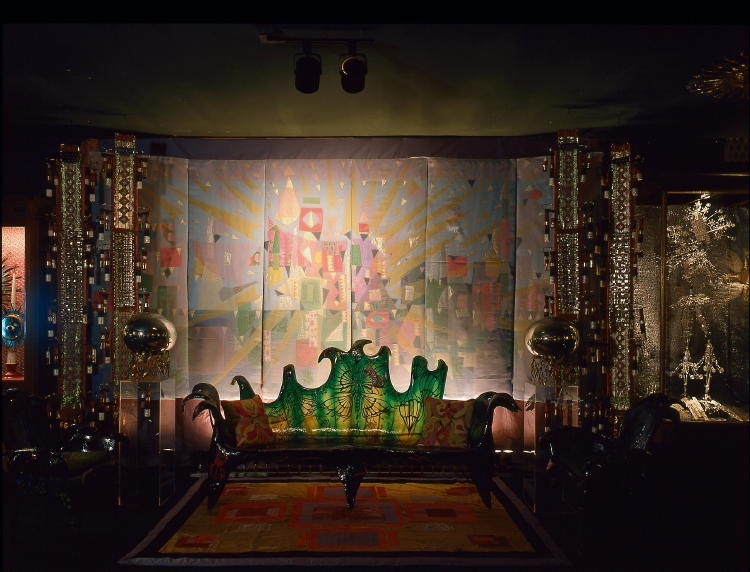
When he found the building it was missing all of its windows, and the first order of business was to seal it up beautifully. Using his favorite material, cast resin, he created amazing inverted conch-shell windows in the two towers and replaced the original stained-glass main window with a creation made from Plexiglas, resin, golf balls, sliced plastic drinking glasses, plastic salad servers from Pic ‘n Save, and all manner of everyday items, which he found beautiful in their repetition.


The main floor of the synagogue would be home to the exhibition. Tony and his volunteer workers created beautiful fabric mosaic tapestries representing the teachings of St. Francis.
An 18th century figure of St. Francis was positioned at the center of the old altar, surrounded by a flock of Rajputani clay birds — perched in dead tree branches — to which he preached a sermon.
Giant faux malachite urns from an 18th century Austrian palace graced the sides of the stage, and behind those were the amazing 15-foot-tall gold-leaf Baroque trees that Tony had prominently displayed for years in his Los Angeles studio.
Above all of this was a giant copper sunburst made from the destroyed and discarded pipes of the building’s original pipe organ. All around the 80-by-80-foot room (and nearing the top of its 40-foot ceilings) ran a horseshoe balcony. It was on this balcony that Tony positioned his army of 28-foot-tall angels, with the 18-foot-tall Madonna in her pavilion holding court at the back. This entire ensemble was artfully hidden by a theatrical scrim, but when the lighting illuminated them from behind, the tableaux appeared and disappeared, to amazing effect.

Under the balcony Tony positioned various sculptures, furniture groupings and works of art.
For this celebratory environment Tony asked his friend Herb Alpert to compose the music. Charlton Heston recited a new poem by Ray Bradbury, and the whole place was set to computerized lighting.
In the basement Tony set up several party rooms and various gallery spaces.


The biggest of these galleries held an exhibition of his wife Beegle’s paintings. The exhibition, like Tony’s other exhibitions, was a brilliant popular success.
Tony Duquette with his goddaughter Liza Minnelli at the Opening of the Duquette Pavilion, April 24, 1987.(5)
Modesto Bee, August 27, 1988
Unfortunately, after being open only a brief time, the entire building — and all of its contents, including the majority of Tony’s personal collections and original works of art — burned February 16, 1989 as the result of an electrical fire.(4)
Modesto Bee, February 17, 1989
                 S.F. FIRE DESTROYS MUSEUM EMPTIES NEARBY CONCERT HALL
A San Francisco museum burned Thursday night, forcing the evacuation of neighbors and thousands of rock fans who were in the nearby Fillmore Auditorium. The fire at the Duquette Pavilion of St. Francis, a converted synagogue at 1839 Geary Blvd., quickly went to five alarms after it was reported at 9:19 p.m. Nearby buildings, including the Fillmore and the old Peoples Temple, were threatened but apparently undamaged. Some 140 firefighters and two dozen engines responded.(2)

The Loma Prieta earthquake of 1989 damaged the Fillmore Auditorium, Temple Beautiful (1839) and the former People's Temple (1859), and all the buildings were damaged by fire. The Fillmore was fully refurbished, but the two other buildings were torn down.

After some time as vacant lots, the 1839 and 1859 Geary addresses are combined as a U.S. Post Office.

Fall 1967 Grateful Dead (rehearsals)
"That fall [of '67] the synagogue next door to the Fillmore closed, and the Dead rented it as a rehearsal hall."(5)

1/12/77 Jerry Garcia Band
1/13/77 Jerry Garcia Band
7/29/77 Jerry Garcia Band
Bob Marley was at the Greek Theater and Willie Nelson was at the Circle Star Theater on this night.
7/30/77 Jerry Garcia Band
8/10/79 Reconstruction (Temple Beautiful)

1.)^Arnold, Corry, July 29-30, 1977: Theatre 1839, 1839 Geary Blvd, San Francisco, CA Jerry Garcia Band, 2009-11-18, Lost Live Dead, http://lostlivedead.blogspot.com/2009/11/july-29-30-1977-theatre-1839-1839-geary.html
2.)^San Jose Mercury News (CA),1989-02-17.
3.)^Arnold, Corry, 1859 Geary Blvd, San Francisco: The Geary Temple 1966-68, Lost Live Dead, 2009-11-17, http://rockprosopography101.blogspot.com/2009/11/1859-geary-blvd-san-francisco-geary.html
4.)^Goodman, Wendy and Wilkinson, Hutton, 2008-11, http://newfillmore.wordpress.com/2008/11/08/from-tony-duquette-a-magical-space/
5.)^McNally, Dennis, Long Strange Trip, pg. 228

Saturday, December 1, 2012

Marshall Leicester's parents home,

Marshall Leicester's parents were a little more negative in their assessment of Jerry's character. After the ever-homeless Garcia spent a couple of weeks crashing at the Leicester family pad, Marshall's parents made it clear to their son that it was time for this charming "freeloader", as they branded him, to move on.(1)


1964?

1.)Jackson, Blair, Garcia: An American Life, pg 40.


Friday, November 30, 2012

Paramount Northwest (Paramount Theatre), 911 Pine Street, Seattle, WA


Scottish-born Seattle resident Benjamin Marcus “Uncle Benny” Priteca, America’s most celebrated architect of movie palaces in the 1920s, designed the building’s adjacent apartments and office suites.
The Rapp brothers began with a substantial handicap: the land for the new theatre was situated on 9th Avenue, blocks from the center of Seattle’s theatre district, and the land was no more than a ravine with a creek flowing to nearby Lake Union. After filling in the land, Paramount Pictures compensated for its new theatre’s remote location by building the largest, most spectacular, most opulent movie palace Seattle had ever seen.


On March 1, 1928, the Seattle Theatre opened. The Seattle Times heralded the occasion with enthusiasm:

"Never has such a magnificent cathedral of entertainment been given over to the public. Indescribable beauty! Incomparable art! The stage productions will be of the most lavish design, brilliant in their lighting effects and gorgeous in their settings.
ALL SEATTLE WILL BE THERE! Show divine at 9th and Pine … an acre of seats in a palace of splendor. It’s yours . . . you’ll love it . . . Everybody’s welcome, everybody’s wanted . . . Every Washingtonian will be proud of its stately magnificence, its gorgeous decorations, its spacious foyers, its wide aisles, its commodious seats, its symphony of lights. See the Mammoth Show! In all the World no place like this!"

Eager customers responded on opening night, lining up eight abreast outside The Seattle. After paying the 50 cent admission fee, they entered the grand lobby. There patrons encountered a lavish interior decorated in the Beaux Arts (also called French Renaissance) style of the palace in Versailles. They were awed by the four-tiered lobby, French baroque plaster moldings, gold-leaf encrusted wall medallions, rich paint colors, beaded chandeliers, and lacy ironwork. Their feet sank into hand-loomed French carpeting as they walked past walls adorned with delicate tapestries and original paintings in gilded frames. Heavy, expensive draperies fell at the windows, and hand-carved furniture upholstered in the finest fabrics lined the first-floor lobby.

Before entering the auditorium, customers were entertained by the rare gold and ivory Knabe Ampico grand player piano in the lounge area just above the foyer.

Patrons were escorted to their places in the nearly 4,000 seat auditorium by what the program booklet praised as an “alert, tactful, well trained” corps of ushers who provided “courteous, unostentatious service.” The program promised “no fuss, no senseless genuflections, but . . . welcome, quiet, considerate and alert attention on the part of each of these ushers — in other words, a gracious host making you feel that his home is yours, suavely, expeditiously, sincerely and without affectation.”(1)

The house lights dimmed, and the Seattle Grand Concert Orchestra began to play selections from Faust. Then customers watched Memories, a silent film the program touted as a “Technicolor novelty.”  They viewed a newsreel, then enjoyed listening to Renaldo Baggot and Don Moore, “Ron and Don, The Organ Duo,” perform “brilliant organ interludes” from the giant “thousand throated,” custom-built Wurlitzer, “an instrument of enchantment” that could simulate many orchestral instruments, “now reverberating in harmonious thunder, now whispering in gentle melody.” The Wurlitzer performance was followed by “A Merry Widow Review,” a nationally acclaimed stage show from The Paramount Theatre in New York City, accompanied by Jules Buffano and The Seattle Theatre Stage Band. The show featured “catchy songs, tantalizing melody, and snappy and graceful dance steps by a bevy of girls.”
The program booklet explained that the stage show was made possible by an elaborate backstage area, which was equipped with “electric elevators, ample windows, and telephones,” and the “last word” in lighting and “advanced stage inventions and appliances” to produce “startling and beautiful stage effects, almost without limitation.”  These effects could include clouds, stars, rainbows and snow.
The booklet also assured satisfied customers, who typically spent four hours at the theatre, that they could look forward each week to new entertainment in a similar format, including stage shows and movies. The first few motion pictures would feature Lon Chaney, Joan Crawford, and Clara Bow.
The Seattle Theatre offered its first “talkie,” Varsity, in early December of 1928, and Seattle customers responded to the innovation with the same enthusiasm as the rest of the country. The movie industry produced almost no silent films after that time.(1)

On March 14, 1930, The Seattle Theatre changed its name to The Seattle Paramount Theatre, reflecting its connection to The Paramount Theatre chain. Vaudeville acts seen at The Seattle Paramount Theatre originated in New York and appeared at Paramount theatres in many other cities.
Performances at The Paramount followed the format of opening night, offering several shows and movies each day. However, as the Depression deepened, fewer patrons could afford theatre. Beset with financial woes, The Paramount temporarily closed in June 1931, and reopened on October 29, 1932.
Upon reopening, The Paramount hired Gaylord B. Carter as its chief organist. Carter’s performances brought him national acclaim, aided in large part by The Paramount’s outstanding organ. It was the biggest and most impressive orchestra-unit organ built in 1928, and included an entire grand piano and drum set built into the side panels of the auditorium, together with hundreds of pipes, bells, chimes, whistles, and horns. It cost over $100,000 to install (it would cost over $1 million today) – a good investment considering that it was used daily for years.(1)

During one memorable week in April 1935, the Marx Brothers performed their stage version of “A Night at the Opera,” testing jokes on Seattle’s audiences for possible use in the movie, released later that year. Tickets for the Marx Brothers show, which The Paramount presented three times a day, cost 25 to 55 cents. “It was the most delightful thing I ever saw,” says Seattle resident Ben Emerson.

Sometime between 1935 and 1937, the Fox Evergreen Corporation purchased The Paramount and continued to present first-run, full-length films.
The Paramount presented vaudeville shows less frequently as the decade progressed. Patron Mary Bassetti reports that by 1937, customers did not know whether a live show would contribute to an “afternoon of glorious make-believe.”
She tells of a visit to The Paramount one Saturday:
The movies finished, the light came up, and my pal Leona and I started to gather our things for the long trolley ride back to West Seattle.
Suddenly, the lights dimmed, a spotlight exploded center stage, and a flamboyant master of ceremonies announced a vaudeville show!  Oh, delicious surprise! We experienced a moment of unmitigated joy to realize we didn’t have to face reality quite yet. With pokes and giggles, we settled back into the plush seats to be transported by lively tap-dancing, glitzy satin, sappy songs, and high-flying Indian clubs – all dessert to our adolescent sensibilities.

Patricia Scott recalls going to The Theatre see Humphrey Bogart in To Have and Have Not on August 14, 1945. When the Japanese surrendered, the house manager stopped the movie to announce that World War II had ended. He distributed passes for everyone to see the show another time, and Ms. Scott joined downtown workers and shoppers as they rejoiced in the streets outside.

Some of the rare remaining live acts in the 1950s included familiar names. Danny Kaye performed at The Paramount in 1952. In 1953, The Theatre offered a production of “John Brown’s Body,” starring Tyrone Power, Anne Baxter and Raymond Massey. Betty Hutton appeared at The Theatre later that year. Danny Kaye returned in 1955, and Ella Fitzgerald sang there in 1958.

Unfortunately for The Paramount, the trend toward building suburban theatres accelerated during the 1950s, and The Theatre’s financial standing slipped. In an effort to make The Paramount’s entertainment more attractive, Fox Evergreen leased The Theatre to the Stanley Warner Cinerama Corporation. The Theatre began showing “Cinerama” films on September 1, 1956. Sixteen hundred seats were removed to accommodate three projection booths at the rear of the main floor, and The Paramount installed a curved, extra-wide screen to show a 1950s version of an IMAX production. By January 26, 1958, The Theatre had discarded the “Cinerama” format, perhaps because the wide screen tended to cut the movie into thirds, separated by shadows.

Mickey Rooney starred in a comedy show at The Theatre as late as 1961.

The Paramount resumed showing traditional full-length films, although by 1960 they were mostly second-run. Nevertheless, The Theatre tried to retain its dignity, continuing to hire ushers (including 20 year-old Bruce Lee, who later became a martial arts cinema star) and showing new releases whenever it could – notably Psycho in 1960 and all the James Bond adventures of the period. The Paramount closed for long periods in the 1960s, including a time in 1965 during which nine magnificent paintings, still in their original gilded frames, were stolen from the lobby. One Friday night in 1967, only 13 people came to see Gone with the Wind — a poignant demonstration of The Theatre’s decline. However, The Paramount limped along as a movie house until 1971.

In 1971, the Clise Corporation purchased The Paramount and began working with Pine Street, Inc., a production company. Pine Street believed that The Theatre’s acoustics would be perfect for rock, soul, and jazz concerts and brought live music back to The Paramount, renaming it Paramount Northwest.
A Seattle resident remembers that point in The Paramount’s history. “The first time I visited The Paramount was also the night of my first rock concert!  I saw The Guess Who there in 1972. Later I bought the record album, The Guess Who Live at The Paramount, and I could see myself in the crowd shot!”


Although The Paramount Northwest retained little of The Theatre’s original luster, the National Park Service and the United States Department of the Interior recognized the building’s architectural and historical significance, placing it on the National Register of Historic Places on October 9, 1974. A plaque attesting to this honor still hangs at the northwest corner of the façade.

In 1976, West Coast Theatres, Inc. began managing The Paramount and continued to offer live music, primarily geared toward the young people of Seattle. The ongoing concert boom in Seattle benefited The Theatre’s owners, but the building remained in disrepair. As Bruce Brown wrote in Argus Magazine in November 1977, “Electric guitars thunder while The Paramount fades.”

In mid-1981, Volotin Investment Company bought The Paramount.

The Paramount was busy, but touring companies found its facilities inadequate. In spite of the 1981 updates, the sound system and lighting remained deficient, and dressing rooms were dingy. The Theatre lacked simple amenities, such as an adequate number of restrooms, a functioning air conditioning system, and access for disabled patrons. The dilapidated backstage area was too small for storage and had no elevator for transporting equipment to the stage. Maneuvering props and equipment to the stage was dangerous. Crews had to use the steep “Kamikaze” ramp; heavy loads occasionally careened out of control, forcing crews to scatter.

The Theatre slid into debt during the 1980s, making repairs impossible. The Volotin Company began selling off The Paramount’s assets. For example, at one auction The Company sold a significant amount of The Theatre’s furniture and equipment, as well as the Knabe Ampico player piano. Dick Schrum, an accomplished musician who had played the Wurlitzer organ for The Paramount in the 1960s, bought the piano.
These fundraising efforts did not solve The Theater’s financial problems. Volotin therefore initiated a search for someone to buy The Paramount. When no buyer materialized, Volotin filed for bankruptcy protection in late 1987.
In early October 1990, a number of investors stepped forward, leaving Volotin with only a small interest in The Paramount. Despite the influx of cash, The Theatre continued to lose money.
Nevertheless, performances at The Theatre continued.

Ida Cole, then a Microsoft vice-president, heard of The Paramount’s financial difficulties from her friend Chip Wilson. Deeply impressed by The Theatre’s grandeur and concerned about its future, Ms. Cole established the non-profit Seattle Landmark Association in 1992 to save, restore and operate local historical theatres. In February 1993, she bought The Paramount for $9.6 million.

Once Ms. Cole owned The Paramount, she and Mr. Wilson, a former promoter and producer, began planning a major overhaul of the facility. By July of 1993, Ms. Cole had hired the international architectural firm of NBBJ to design the project and Sellen Construction of Seattle to implement it. She applied for the necessary city permits and acquired adjoining property to accommodate the expansion of the stage and backstage areas.

Ida Cole hoped to restore The Paramount to a “kissable” building, one where “everyone was welcome and felt comfortable, the people’s theatre.”  She promised that all work would “be done within the context of protecting the irreplaceable historical aspects of the building,” and she was true to her word.

The Paramount reopened on March 16, 1995, launching the new touring production of “Miss Saigon.” 

Then, in 2001, as a fitting tribute to The Paramount’s restored grandeur, the family of Dick Schrum agreed to display the Knabe Ampico player piano in its original location in the lounge area just above the foyer. The family still owns the piano, but Ida Cole refurbished and agreed to maintain it so long as it remains at The Theatre.

On Friday, December 20, 2002, Ida Cole transferred ownership of The Paramount Theatre to Seattle Theatre Group (STG), the new name for the Seattle Landmark Association. Ms. Cole told The Seattle Times that she had enjoyed restoring the building but wished to divest herself of the enormous responsibility of owning The Paramount. As a parting gift, she personally reduced the mortgage on the building from $14.5 million to a more manageable $8.5 million, bringing the total amount of money she had invested in The Paramount to $30 million. In recognition of her outstanding contribution, the auditorium was officially named after her at The Theatre’s 75th anniversary celebration on March 1, 2003.(1)

7/21/72 Grateful Dead (Paramount Northwest Theater)
7/22/72 Grateful Dead (Paramount Northwest Theater)
9/28/77 Grateful Dead (Paramount Northwest)
9/29/77 Grateful Dead (Paramount Northwest)
10/28/78 Early and late shows Jerry Garcia Band (Paramount Northwest Theater)
1/13/84 Jerry Garcia Band (Paramount Theater)
12/8/84 Jerry Garcia Band (Paramount Theater)

1.)^Peltin, Nina, The Paramount Theatre:"Show Divine at 9th and Pine", http://stgpresents.org/paramount/

Symphony Hall, 301 Massachusetts Avenue, Boston, MA


Capacity 2625
Symphony Hall in Boston, Massachusetts is widely considered to be one of the two or three finest concert halls in the world, alongside Amsterdam's Concertgebouw and Vienna's Großer Musikvereinssaal. All three concert halls are renowned for their exceptional acoustics.
The architects, McKim, Mead & White of New York, engaged Wallace Clement Sabine, a young assistant professor of physics at Harvard, as their acoustical consultant, and Symphony Hall became one of the first auditoria designed in accordance with scientifically derived acoustical principles. Stage walls slope inward to help focus the sound. With the exception of its wooden floors, the Hall is built of brick, steel, and plaster, with modest decoration. Side balconies are very shallow to avoid trapping or muffling sound, and the coffered ceiling and statue-filled niches along three sides help provide excellent acoustics to essentially every seat.

Symphony Hall was inaugurated on October 15, 1900, with an inaugural gala led by music director Wilhelm Gericke, after the Orchestra's original home (the Old Boston Music Hall) was threatened by road-building and subway construction.

In 2006, due to wear and tear, the concert stage floor was replaced at a cost of $250,000. The process used original methods and materials, including hard maple, a compressed wool underlayment and hardened steel cut nails, hammered home by hand. The vertical grain fir subfloor from 1899 was in excellent shape and was left in place. The nails used in the new floor are made using the same equipment that produced the originals. Even the back chanelling on the original maple top boards was replicated to help preserve the acoustics of the Hall. The old floorboards were converted into handcrafted pens that are available to the public on a necessarily limited basis.
The 16 replicas of Greek and Roman statues are related in some way to music, art, or literature. They were placed in the niches as part of an appreciation of the frequently quoted words, "Boston, the Athens of America," written by Bostonian William Tudor in the early 19th century. The Symphony Hall organ, an Aeolian Skinner designed by G. Donald Harrison and installed in 1949, is considered one of the finest concert hall organs in the world.
The hall's leather seats are still original from 1900.

A couple of interesting points for observant concert-goers: Beethoven is the only composer whose name was inscribed on one of the plaques that trim the stage and balconies; the other plaques were left empty since it was felt that only Beethoven's popularity would remain unchanged. The initials "BMH" for "Boston Music Hall", as the building was originally to have been called, appear on the stairwell banisters at the Huntington Avenue side, originally planned as the main entrance. The old Boston Music Hall was gutted only after the new building, Symphony Hall, was opened.(1)

1/26/72 Howard Wales
1/27/72 Howard Wales

1.)^The History of Symphony Hall, http://www.bso.org/brands/symphony-hall/about-us/historyarchives/the-history-of-symphony-hall.aspx?sa=t&rct=j&q=&esrc=s&source=web&cd=5&ved=0CJsBEIwQMAQ&url=http%3A%2F%2Fwww.bso.org%2FHome%2FBranding%3Fbrand%3D6426%26linkForward%3D26645&ei=LEy8T8r2L6qFiALqx4GTDg&usg=AFQjCNFztbctt91JouTh4PlV5izCv9eWuA&sig2=F7WXxBYXP0ZGVJFEUHULsA

Wednesday, November 28, 2012

David McQueen's (David X) other house, Waverly at Channing, East Palo Alto, CA

Also see David McQueen's (David X) other house, Ramona Street, Palo Alto, CA.

Veteran's Memorial Auditorium, 1 Avenue Of The Arts, Providence, RI


Capacity 1931
Veterans Memorial Auditorium (VMA) is a performing arts theater in Providence, Rhode Island.
The Rhode Island Freemasons planned an ambitious complex designed by Osgood & Osgood, one of the era’s noted architectural firms. Work began in 1927, and foundations and building frames were constructed before economic times changed drastically in 1929. Work was halted, and the project lay dormant until the 1940′s.
The State of Rhode Island took over the project in the 1940′s. Near the end of World War II, the community pushed to complete the theater component as Rhode Island’s first professional performing arts venue.

On January 27, 1950 the theater officially opened.
Photo by Gerry D.

It is among the oldest arts venues in Rhode Island and is on the National Register of Historic Places.(1)
The ornately-designed concert hall houses the largest theater stage in Rhode Island and is considered to have some of the best acoustics in New England. The performance space features a gilded proscenium arch, allegorical and heraldic ceiling murals.

The protection of the auditorium's highly acclaimed acoustics, and sound separation of the ballroom from the auditorium above it, were a shared concern in the property development agreement between the non-profit VMA organization and Sage Hospitality Resources, the developers of the Masonic Temple site. Specifications for the acoustic isolation of the auditorium and ballroom were created by the noted acoustic firm Shen Milsom & Wilke, in conjunction with Odeh Engineers, Inc. Shen Milsom & Wilke are well regarded for the results of the sound separation between Carnegie Hall and the new Zankel Hall created beneath it.

Muddy Waters 1969, Vets Memorial

It was completely restored in 1990.

Veterans Memorial Auditorium is managed by Professional Facilities Management, the company that brings you the Providence Performing Arts Center (PPAC). Under the guidance of the Rhode Island Convention Center Authority and PPAC/PFM team, The Vets will undergo major renovations in the coming months/years to add more patron conveniences and improve the overall theater experience

Ceiling feature with display of flags of RI towns and cities, photo by Gerry D.

Since 1950, when the theater opened, it had begun to fall into disrepair and in the early 1980s the state of Rhode Island was thinking of closing the auditorium and the adjoining Masonic Temple and reducing the complex to a parking lot. In 1983, the Veterans Memorial Auditorium Preservation Association (VMAPA) was formed to try to save the auditorium. They rallied for five years and in 1988 Governor DiPrete awarded the VMAPA with $5 million for the VMA's renovation. Since that time it has been a center for the arts. The Renaissance Providence Hotel, formerly the Masonic Temple, is located directly adjacent to the VMA.(1)

11/29/83 Jerry Garcia Band

1.)^Fernandes, Paul, http://www.rirocks.net/Search/VeteransMemorialAuditorium.htm
2.)^Barbarisi, Daniel (May 20, 2007). "Temple Digs", Providence Journal.