Showing posts with label G-Venues. Show all posts

Saturday, November 3, 2012

Nevada County Fairgrounds, 11228 McCourtney Road, Grass valley, CA

First Fair - 1884, fairs at this location since 1938.
More than 3,000 trees on 100 acres.
Lions Lake is 4.5 acres, fishing for children 12 & under.
Approximately 25 acres of shaded parking.
Shaded site camping for trailers and motor homes.
Five large exhibit buildings.
Barns for more than 1,000 animals.

There are five stages, Pine Stage, Budweiser True Music Stage and Tumbleweed Stage play music. There is also an outdoor arena(1)


Jerry performed here on
7/24/83 Jerry Garcia Band
9/18/83 Grateful Dead


1.)^http://www.nevadacountyfair.com/rental/

Friday, October 19, 2012

War Memorial Gym, 2335 Golden Gate Avenue, University of San Francisco, San Francisco, CA


 Capacity 5300


The college moved to its present site on the south slope of Lone Mountain in 1927. The college was built on the site of the former Odd Fellows, Mount Olivet and Masonic Cemeteries. In 1913, the city enacted a law prohibiting more burials in the City and County of San Francisco. The remains were transferred to Colma, California.

To celebrate its diamond jubilee in 1930, St. Ignatius College changed its name to the University of San Francisco. According to USF history professor Father John B. Mc Gloin, S.J., the change from college to university was sought by long-time San Francisco Mayor James Rolph Jr.. at the time, running for Governor of California.

Prior to 1958, the USF basketball team had no permanent home. During the 1955 and 1956 NCAA championship seasons, Phil Woolpert's teams had to practice and play home games at either nearby Kezar Pavilion in Golden Gate Park or the gym at neighboring St. Ignatius High School. The aftermath of USF's back-to-back national championships spurred a fund-raising effort that ultimately made building an on-campus venue possible and in 1958, War Memorial Gym opened its doors.


A male-only school for most of its history, USF became fully coeducational in 1964.

Originally serving all of USF's athletic needs, War Memorial Gym also briefly hosted the San Francisco Warriors during the 1966-1967 season. Upon the arrival of women's sports on campus, War Memorial Gym also became the home of the women's basketball and volleyball teams.

Though the gym missed the Russell and Jones era by three years, it was the home of the great Dons teams of the late 1970's led by Bill Cartwright, Phil Smith and Quintin Dailey (though some high-profile matches were held at the Cow Palace or the Oakland Arena).

War Memorial Gym was also the site of CBS's first national college basketball broadcast, a 1982 match-up between USF and the University of Georgia.

In 1989, with the construction of the Koret Health and Recreation Center, War Memorial became exclusively an athletic venue, though training facilities continue to be housed in the Moran Center beneath the gym.
Dedicated to the USF dead of World War II, the Korean War and the Vietnam War, War Memorial Gym currently seats 5,300 spectators.  Plaques in the lobby display the names of more than 100 students, alumni, and faculty who died fighting those wars.(1) Above the court can be seen banners commemorating USF's national and conference championships in basketball, including titles won by the women's basketball team in their old conference, the Northern California Athletic Conference. Players' retired numbers can also be found, including banners for Pete Newell and Phil Woolpert. The gym's foyer houses a mini-hall of fame, displaying trophies and memorabilia from USF's athletic history.(2)

In 2008 and 2009, USF made upgrades to the gym. The old floor, which was the original installation, was replaced, along with the bleacher seating in the upper level. The old baskets were replaced with stand-alone versions, and new banners were installed.


Jerry performed here on
10/31/74 Merl Saunders


1.)^https://www.usfca.edu/virtualtour/war_memorial_gym/
2.)^Norris, Ryan, No Frills on the Hilltop, http://www.stadiumjourney.com/stadiums/war-memorial-gym-s829/

Sunday, September 16, 2012

Guitars Unlimited, El Camino Real, Menlo Park, CA


Since Dana Morgan Jr. had been fired from the Warlocks, the band was not welcome to use equipment from the store, nor were Garcia and Weir wanted as guitar instructors. Both Garcia and Weir got jobs at a music store called Guitars Unlimited on El Camino Real, right near Santa Cruz Avenue. Both of them brought their own guitar students with them, an attractive proposition even though Garcia in particular had what was perceived as a "menacing" demeanor. Of course, the band promptly borrowed equipment from Guitars Unlimited.(1)

Neal Winslow - Lead Guitar  Neal grew up on the Peninsula and was lead singer for several bands during high school and college. Neal expressed interest in learning to play the guitar and took a few lessons from Jerry Garcia when he was teaching at Guitars Unlimited in Menlo Park, this is rumored to be the reason that Jerry left teaching to form the Warlocks (predecessors to theGrateful Dead).(2)


Jerry rehearsed and taught here in
1965.


1.)^Arnold, Corry, Lost Live Dead, 2010-02-06, The Grateful Dead and Menlo Park
2.)^http://www.hydestreet-band.com/?section=bio , biographies

Wednesday, September 12, 2012

Main Gym, Orange County Community College, 115 South Street, Middletown, NY

 Capacity 3000

S.U.N.Y. Orange was founded in 1950 as the first county-sponsored community college in the State University of New York system.

Physical Education Building's Main Gym.

The physical education facility contains six handball courts, a swimming pool, the main gymnasium (capacity 3,000), human performance lab, three classrooms, and an exercise room. Adjacent to the building are soccer and softball fields and tennis courts.


Jerry performed here on
8/15/84 Jerry Garcia Band

Monday, September 10, 2012

Grande Ballroom, 8952 Grand River near Joy, Detroit, MI

Opened 1928
Architect: Charles N. Agree
Builder: E.W. Wood and Co.
Owner: Harry Weitzman

Originally served as a multi-purpose building, hosting retail business on the first floor and a large dance hall upstairs.[1] During this period the Grande was renowned for its outstanding hardwood dance floor which took up most of the second floor.

These Stone Initials appear beneath the windows at each corner of the Grande. All other windows featured an iron "window box" grating.
They are the first initials of Harry Weitzman's three children. His children were Clement, Dorothy and Seymour Weitzman.


December 12, 1944 Photo Courtesy The Burton Collection Detroit Public Library

1950's
Grand Opening 1966
In 1966 the Grande was acquired by Dearborn, Michigan, high school teacher and local radio DJ Russ Gibb. The property was leased from an attorney and land speculator named Gabe Glantz. Gibb was inspired by visiting San Francisco's Fillmore Theater, and envisioned a similar venue in Detroit for the new psychedelic music and a resource for local teenagers. Gibb worked closely with Detroit counterculture figure John Sinclair in bringing in bands, both from San Francisco and harder-edged psychedelic rock bands gathering around Detroit's Plum Street community like the MC5.
Russ Gibb


1967

Grande back door

The Jeff Beck Group - November 1-3 1968
The line-up for this outing featured:
Jeff Beck - Guitar
Ron Wood  (Pre-Small Faces and Rolling Stones) - Bass
Nicky Hopkins - Piano
Mickey Waller -Drums
Rod Stewart  (Pre-Small Faces) - Vocals

Led Zeppelin performed here on three consecutive nights, January 17-19, 1969.

The Grande also featured the avant garde jazz of John Coltrane and Sun Ra.[3]
Performances of this period were frequently advertised by the distinctive psychedelic handbills of Gary Grimshaw and Carl Lundgren.[4][5] The Grande's rock and roll countercultural experience was extensively documented by Detroit photographer Leni Sinclair.[6]

Since Gibb closed the Grande as a rock venue in 1972, the building has rarely been used and has fallen into a state of disrepair. The last gig at the Grande was December 31, 1972 and also happened to be the last gig the MC5 ever played.

The MC5 was considered the "house" band. One of the most memorable shows was when the MC5 opened for Cream. They obviously wanted to steal the show and they certainly did. At the end of their amazing set, during the normal wild finale, as John Sinclair was blowing the saxophone and some guy was standing there naked, they ripped up an American flag. Then they brought out a big bed sheet with the word "freak" written on it.
They yelled, "This is our new flag!"
Somewhere during the show, the drummer, Dennis Thompson, passed out. They carried him off the stage. A few minutes later they brought him back out, yelling, "He's all right! He’s going to play!"
It was a wild scene.

Cream was pretty good too, but they had a hard time matching the intensity of the MC5.

"I remember an Airplane show on a Sunday nite/2 show nite/ I hid all my friends in the attic so they wouldn't have to pay for the second show......well, we got high with Grace, Paul and Jorma...Jerry and Phil and Bob showed up about 12:30am and jammed with the Airplane till about 4:00am...Terry Reid also played two sets."(Craig Maceachern on dead.net)


The dance hall was on the 2nd floor.

This is how it looked in 2003.
 Ownership of the Ballroom transferred in 2005 from one church to another.
Summer 2009


As of 2010 it remained inactive and open to redevelopment.[1]


Jerry performed here on
11/24/68 Jefferson Airplane (7)
"worked at the Grande for 3 yrs......the Dead, the Airplane and Procol Harum were the best of all.........I remember an airplane show on a sunday nite/2 show nite/ I hid all my friends in the attic so they wouldn't have to pay for the second show......well, we got high w/Grace, Paul and Jorma.........Jerry and Phil and Bob showed up about 12:30 and jammed with the Airplane til about 4:00 in the morning."(7)
8/11/67 Grateful Dead
8/12/67 Grateful Dead
12/1/68 Grateful Dead


1.)^ Austin, Dan (2009). "Grande Ballroom". Buildings of Detroit.
2.)^McCollum, Brian (1 October 2006). "Strobe Lights, Longhairs and the Smell of Pot: 40 years later, rockers remember Detroit's Grande Ballroom". Detroit Free Press.   
3.)^http://www.motorcitymusicarchives.com/grandecal.html

4.)^ "Gary Grimshaw Biography". Gary Grimshaw Music Art. 2006.  5.)^Lundgren, Carl. 5.)^Lundgren, Carl."Artobiography". Carl Lundgren Art Studios.
6.)^Handyside, Chris (4 February 2004). "Leni Sinclair: Rock photography’s overlooked grand matriarch". Metro Times (Detroit).
7.)^Maceachern, Craig, Dead.net


Thursday, September 6, 2012

Garcia's garage, 351 Bryant Court, Palo Alto, CA

Weir had just met Garcia (as he says, on New Year’s Eve, 1963). “I think I first met Pigpen in Garcia’s garage in Palo Alto at the first jug band rehearsal. Garcia had said he knew this guy Pigpen who played real good blues; and even though he’d been around, I’d never really heard about him until that day.”(1)

"The jug band rehearsed anyplace it could--at the Hamilton Street pad, Weir's parent's house or, as likely, in the garage of the cozy two-bedroom cottage Jerry and Sara rented after he returned from his eastern odyssey.
Three-fifty-one Bryant Court was a sunny little house with a small yard surrounded by a white picket fence, a great improvement over their previous residence."(2)

Jerry rehearsed on
12/31/63 Bob Weir, Ron "Pigpen" McKernan
Other numerous unknown dates

1.)^http://deadessays.blogspot.com/2011/04/pigpen-solo.html
2.)^http://www.postertrip.com/public/5568.cfm

Sunday, July 22, 2012

Marx Meadow, Golden Gate Park, 899 John F. Kennedy Drive, San Francisco, CA

Marx Meadow in Golden Gate Park was established in 1907. The meadow is named for a Napa resident, Johanne Augusta Emily Marx, who left a donation to the park.  She was worth $146,000 when she died in 1912.(1)
It's perfect for kicking back and relaxing in between frisbee with the dog, disc golf or kicking your hackey sac around for a bit.

Marx Meadow, Golden Gate Park


Part of the vast "chain of meadows" in this middle section of Golden Gate Park, Marx Meadow is located near Fulton Street and the 25th Avenue park entrance. It's a sloping bowl of lawn bordered on two sides by the Disc Golf Course. The meadow is named for a Napa resident, Johanne Augusta Emily Marx, who left a donation to the park.  She was worth $146,000 when she died in 1912.(1)


BUDDHIST PRAYERS BRING RAIN
By Bhiksuni Heng Hsien
Buddhist Text Translation Soc.
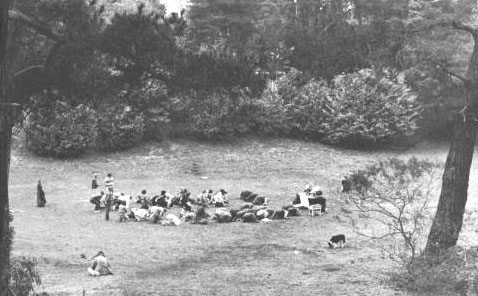
Anyone who was in Golden Gate Park on Saturday, February 19, 1977 for the Dharma Gathering for rain sponsored by the Sino-American Buddhist Association of Gold Mountain Temple, 1731 15th Street San Francisco, can testify to one thing: the people present were really working hard for rain. Arriving well before dawn, the Sino-American sponsors quickly unpacked their equipment, scoured the area of debris, and by sunrise had created a formal altar with a golden statue of their Original Teacher, Sakyamuni Buddha, and a picture of the spiritual being whose compassion was to be especially sought that day: the Bodhisattva Gwan Shr Yin. Offerings of flowers, fruit and incense framed the images, while Dharma instruments lay on the red velvet altar cloth waiting to be played. A brilliant gold banner, lettered with the invocation: NAMO GWAN SHR YIN PU SA, was stretched across the far end of the meadow, and the foreground was dotted with dragon-bearing posters (dragons make rain) pointing to where the SABA banner was suspended in the breeze, each poster with the announcement, DHARMA RAIN. The host-participants wore robes, some black, others subdued blue or grey, and sashes of earth tones. Those who had left the home life as monks and nuns had their heads freshly shaved, a symbol of renunciation. All had an air about them of joyous intensity and seriousness of purpose. They had already been reciting prayers and mantras for the entire week previous to the Gathering. To represent their sincerity, many of them, including those whose regular practice is to eat only one simple vegetarian meal a day, had decided not to eat at all that day, and perhaps not the next if it did not rain. One monk had been fasting to end the drought since the previous Tuesday, and had made the vow not to eat again until it rained.
The weather forecast gave no hope of rain, for a minimum of two full weeks ahead, due to the high-pressure zone off the coast, which was blocking storm clouds unseasonably. The days prior to the Gathering, temperatures reached a high of 75-76 degrees with bright sunshine drought weather in the middle of winter, the culmination of two years of scarcity of rain. As the day of prayer and chanting opened officially at seven A.M., approximately one third of those present piled into The Great Vehicle, the Sino-American Buddhist Association's converted city bus, and headed for the Bandshell to begin the procession back to Marx Meadow, chanting NAMO GWAN SHR YIN PU SA. NAMO means "homage," and PU SA is short for "Bodhisattva," that is, a being who is enlightened and who enlightens other beings. GWAN SHR YIN, whose Sanskrit name is Avalokitesvara, is the Bodhisattva who embodies infinite compassion, in much the same way as does the Virgin Mary in the West. But whereas the Virgin Mary is known as the Mother of Jesus, Buddhists feel the Bodhisattva Gwan Shr Yin is the compassionate Mother of every single person. As one of the nuns from Gold Mountain said in her talk that day, "You might forget her name; but if you ever saw her, you'd never forget her thousand arms and all those heads." The multitude of hands and eyes and arms represents the ability of the Bodhisattva to rescue all living beings at once, under any circumstances, anywhere. Buddhists teach that Gwan Shr Yin Bodhisattva universally responds to invocations, and that anyone who is sincere will obtain a response, rescue from difficulties and relief from pain.
NAMO GWAN SHR YIN PU SA, then, was what they chanted as they walked from the Bandshell to Marx Meadow, their strides slow and solemn, and most of them bareheaded on that unexpectedly cold and foggy morning. The procession took one hour to reach the Meadow, where the monks, nuns and lay people were reciting a mantra before the altar. Their number had been augmented by members of the general public, who may or may not have believed in Buddhism, but who were united in their wish for rain. As the crowd repeated the chant, the fog began to swirl, as the wind picked up and blew through the meadow.  The ceremonies continued: recitation once again of NAMO GWAN SHR YIN PU SA while circumambulating the altar, then sitting, more recitation, followed by the formal meal-offering for lunch. Those who were fasting continued to recite mantras and, when rejoined by those who had eaten, began another procession, this time from Marx Meadow to the Bandshell.
Recitation of the mantra there gave way to informal talks and lively songs, as the monks and nuns of Gold Mountain, no longer solemn and intense, explained to their fellow San Franciscans just why it was that they were having a drought. "We've been too selfish and greedy, and we've wasted water," they said, "But if we can admit our mistakes and change for the better, the sincerity of our repentance and reform can evoke a response. If we don't change for the better, however, we are sure to experience far worse troubles. Due to everyone's becoming greedier every day, and having more and more hatred and being more and more stupid, our very lives are in danger each moment, for we have reached the point where our weapons could destroy all life on this planet. That is the real danger which we face right now, beside which a water shortage or even a famine, scarcity of energy or a lack of consumer goods is insignificant." Their message was, as Buddhism teaches, that individuals are responsible for the situations in which they find themselves, and so are people as a group; that there is retribution in kind for everything one does or omits to do. "Plant good causes and you will reap good results' plant bad causes and you will reap bad results," they told the crowd, which meant that each one of us is responsible for whether we have timely rain or not.
Seeking rain, participants in the Dharma Gathering for Rain, held in Marx Meadow, Golden Gate Park, San Francisco, February 19, 1977, bow before the Buddha altar with sincerity and concentration.
After talks in the Bandshell, a great many people joined the procession chanting Gwan Yin's name back to Marx Meadow, as reporters took pictures and films for television. Once again before the altar, all the participants joined in the sincere and intense chanting, now kneeling on the bare, damp ground, now bowing in full prostrations to the ground, now circumambulating the altar as they recited. Later in the afternoon as the mantra was recited, actual rain clouds began to form, and some people saw golden dragons in the sky and in the trees. At one point, before the Dharma Gathering was to end at six P.M., the rain clouds, which had formed, moved in from the West and covered the city. Clearly it would only be a short time before it rained. As the crowd dispersed with nightfall, the Buddhists from Gold Mountain, after twelve solid hours of concentrated effort seeking rain, returned to their Temple for the daily seven P.M. Sutra lecture and evening worship.
After that, did it rain? At the City of Ten Thousand Buddhas, the Sino-American Buddhist Association's new center in the Ukiah Valley, one hundred and ten miles north of San Francisco, it began to rain early Sunday morning.  It was around 11:30 A.M. that Sunday when the massing rain clouds one could see over the city pelted San Francisco with rain. People started calling Gold Mountain to ask how long it would continue to rain. It was still raining Monday when Susan Hewitt, reporter for Eyewitness News, KPIX channel five, who had covered the Gathering on Saturday, returned to Marx Meadow for an on-the-spot report. Right there had stood the altar, she pointed out, where the Buddhists had prayed for rain. Now it was raining, just as they had sought, and where the altar had stood was a huge puddle of water. That confirmed it for the city and when people saw the monks and nuns of Gold Mountain on the streets, often they would thank them for the rain. But, as was then pointed out, anyone can evoke such a response by sincere and unselfish self-examination, repentance and reform, and invocation. The power of repentance and prayer is not the sole preserve of one particular religious group. As long as people embody the compassion of Gwan Shr Yin Bodhisattva, do not fight with each other, and do not waste water, there is every hope for timely rain.(2)


Jerry performed here on
9/2/74  Legion of Mary
5/30/75 Diga Rythm Band


1.)^California District Court Of Appeals, California Appelate Decisionss, Volume 22, pg. 428, http://books.google.com/books?id=1mkEAAAAYAAJ&pg=PA428&lpg=PA428&dq=Marx,+a+napa+resident&source=bl&ots=ebn38vwqx2&sig=uviACz96P08oNx-s6T7SfhkGg3Q&hl=en&sa=X&ei=GmkLUJ_GDYOw2QW_16wn&ved=0CFUQ6AEwBQ#v=onepage&q=Marx%2C%20a%20napa%20resident&f=false
2.)^http://www.drbachinese.org/vbs/1_100/vbs808182/80_19.html

Sunday, April 22, 2012

Golden State Recorders, 665 Harrison Street, San Francisco, CA


Leo De Gar Kulka (a.k.a.“The Baron”) migrated from L.A. to San Francisco in 1964 to open Golden State Recorders at 665 Harrison Street between 2nd and 3rd Streets, a gritty area at the time, now a mix of modern lofts, fancy restaurants, and the Giants’ home, AT&T Park.
The Czech-born Kulka was new to the Bay area when he first started recording bands for Autumn Records. All through the 50's and early 60's he's worked at L.A. studios-first at Radio Recorders, then at his own facility, International Recorders, where he cut tracks with such artists as Frank Sinatra, Nat King Cole, Little Richard, Herb Albert, Sam Cooke and many others. A classic example of the “mom and pop” studio, Leo Kulka ran the studio and engineered most of the sessions. He employed a small staff, including band office manager/bookkeeper, one staff engineer, and an assistant engineer. On busier days, his wife came in to help out.
For the first few years, that small group ran one of the few music recording studios in town with a recording room comparable in size to established L.A. and New York facilities. The studio area was
at least 50×50 feet, with high ceilings, a vocal booth, and the requisite gobos to break up the square footage during a session. “At the time it was a good room; a big box, really,” George Horn describes
it bluntly. “One of the advantages of [the room’s size] was you could record a broad variety of music,” adds Vance Frost, who worked as an assistant engineer at Golden State in 1968. He returned in 1971 to serve as its lead engineer and manager until 1976. “We’d do large-scale recordings, like big bands, a few orchestral dates, and 30- to 60-voice gospel choirs.” Golden State had the size but it lacked the pristine quality of certain major market studios—which is just why a lot of clients liked it. Reflecting the no-nonsense attitude of its owner, Golden State felt lived in and unpretentious. It didn’t have much in the way of décor—no colored lights, no dimmer switches. You had two options: lights on, lights off —all or nothing. Kulka did add a few switches later so clients could at least control which lights turned on and off. He had a Neumann mastering room at Golden State as well, along with a custom 4-bus console built by staff engineer Mike Larner. Th is was later expanded to 8-bus.

A live echo chamber, accessed by walking through the electrical shop behind the control room and climbing up a ladder and through a porthole, added character—and still more reverb—to an already live room.

In addition to the handmade gear, Golden State offered an Ampex Model 200 (the first model issued by the Bay Area–based company), brought by Kulka from L.A., as well as a couple of
AG440 mono 2- and 4-track machines and at least one Ampex 350 reel-to-reel recorder. All great machines, but Kulka was slow to upgrade: When 16-track became available in the late 1960s, Golden
State hung back at four.
In its early years, Golden State, and Kulka’s engineering skills, appealed mostly to a niche of respected soul and blues artists, including Rene Hall and Wally Cox. Both of these artists already had a few decades of experience under their belts when they recorded with Kulka at Golden State. Kulka also signed some of these acts himself, either leasing sides to outside labels such as MTA and Acta or issuing singles through his Golden Soul imprint. Much of this material remained unreleased until decades later, when the public discovered his recordings from San Francisco TKOs, The Savonics,
The Spyders, Jeanette Jones, and The Generation (featuring Lydia Pense, later of Cold Blood).
Golden State Recorders

Interior
 The studio also attracted a few L.A.–based artists and producers and a solid cast of local musicians, such as the Beau Brummels, Sons of Champlin, Big Brother & the Holding Company, The
Charlatans, and a slew of obscure acts. Some achieved later success, while others—such as the C.A. Quintet (oddly, from Minneapolis, but they recorded their first and only album at Golden State)—
remained relatively unknown.
The same year Golden State opened its doors, the Beau Brummels recorded Introducing the Beau Brummels for Autumn Records with producers Bobby Mitchell and Sylvester Stewart
(a.k.a. the infamous Sly Stone), which included their first hit, “Laugh Laugh.”

In 1965, label co-owners Tom Donahue and Mitchell brought in another one of their acts: an odd blues- and R&B-influenced rock band called The Warlocks. Half a year earlier, they had been
an anarchic acoustic group called Mother McCree’s Uptown Jug Champions. In one day at Golden State, they recorded six songs— four originals, one traditional, and a cover of Gordon Lightfoot’s
“Early Morning Rain”—none of which were ever released until a box set 30 years later. With Kulka at the board, they recorded under the name The Emergency Crew, reportedly because bassist
Phil Lesh had spotted an album in a record store by another group called The Warlocks. Soon after, they permanently changed their name to the Grateful Dead, putting an end to any risk of band
name infringement.
They brought many other groups to Golden State to record under the Autumn Records banner, often with the help of Stewart, their secret weapon. In addition to the Beau Brummels, Stewart produced Bobby Freeman’s hit “C’mon and Swim” and other cuts for the Mojo Men, The Vejtables, and the Great Society. This last group was the launching pad for future Jefferson Airplane siren Grace Slick.

In 1969, producer Elliot Mazer came by to finish a portion of Nick Gravenites’ album, My Labors, at Golden State. Much of the album came from the same sessions that produced Live at Bill Graham’s Fillmore West by Michael Bloomfield (recorded with Kulka’s remote truck).

Business began to slow at Golden State in the early 1970s as other facilities made their way into the city. The most notable of these was Wally Heider Recording. Musicians, fickle as they can be,
wanted to record at the “in” studios with the “in” equipment, which put a dent in Golden State’s business.

Leo loved to experiment with new recording techniques, but he was a traditionalist at heart. He used a “back to basics” approach with his students. To the end, Leo waxed ecstatic over his Ampex model 200 (the first tape recorder produced in this country). And he may have been the last living audio engineer to edit tape without a splicing block or a razor blade. He’d lay a section of tape across his left hand, precisely lining it up with his thumb and finger, and using a small scissors, he made fast splices that always joined perfectly.


There is a Golden State Recorders located at 1241 Swordfish Street, Foster City, CA. It's not related.


Jerry recorded here on
11/3/65 Emergency Crew (demo for Autumn Records)
7/3/66  Grateful Dead. They cut six songs at Golden State-four originals, including a Dylanesque     number sung by Garcia called "I Can't Come Down", a Pigpen locomotive romp known as "Caution(Do Not Stop On Tracks)", and covers of Gordon Lightfoot's "Early Morning Rain"(lead vocal by Phil) and the old folk chestnut "I Know You Rider".(2)


1.)^Johnson, Heather, If These Halls Could Talk: A Historical Tour through San Francisco Recording Studios
2.)^Jackson, Blair, Grateful Dead Gear: the band's instruments, sound systems, and recordin, pg. 22+23

Thursday, April 12, 2012

Great American Music Hall, 859 O'Farrell Street, San Francisco, CA

Opened in 1906 as Blanco's Cafe, it sat next to Blanco's Hotel and Restaurant, run by “Blind Boss” Chris Buckley, a saloon keeper and neighborhood political organizer who became “boss” of San Francisco’s Democratic Party in the 1880s. Until he was deposed by a grand jury in 1898, Buckley made sure the Southern Pacific Railroad got what it wanted and ran the City the way he wanted by controlling a corrupt municipal government in the interest of graft.

Sometime in the mid-1870s,  Chris Buckley went blind. Hence, The "Blind Boss"


San Francisco's oldest and grandest nightclub, the Great American Music Hall, carries guests back to an earlier, more elegant era, with its ornate balconies, soaring marble columns and elaborate ceiling frescoes.
The remarkable interior design came from an unlikely duo: a French architect, Architect: A.W. Edelman, who designed the building in 1907, and Chris Buckley, a political mover and shaker who wanted to erect a grand structure after the devastating 1906 earthquake. The result was Blanco's, characterized as one of the most popular entertainment spots during San Francisco's notorious Barbary Coast Era. The restaurant/bordello offered fine food, gambling and fast women right up until the dark days of the Great Depression in 1933.

Three years later, in 1936, the extravagant and elaborate fan dances of local favorite, Sally Rand, brought new life to the dark building. Sally Rand (April 3, 1904 [1] – August 31, 1979) was a burlesque dancer and actress, most noted for her ostrich feather fan dance and balloon bubble dance. She also performed under the name Billie Beck. Cecil B. DeMille gave her the name Sally Rand, inspired by a Rand McNally atlas.
She had been arrested four times in a single day during a fair due to perceived indecent exposure while riding a white horse down the streets of Chicago, but the nudity was only an illusion. She also conceived and developed the bubble dance, in part to cope with wind while performing outdoors. She performed the fan dance on film in Bolero, released in 1934.
Sally and The Bubble
 
In 1936, she purchased The Music Box burlesque hall in San Francisco, which would later become the Great American Music Hall.  It remained as The Music Box until 1946.


In 1939, our girl hosted Sally Rand's Nude Ranch at the Golden Gate Exposition in San Francisco.  It was housed at a night spot called The Music Box and featured women wearing cowboy hats, gun belts and boots, and little else.  Sally's show was only one of several "flesh" shows in the Treasure Island Amusement Zone, also known as the "Gayway."  [Something tells me that name won't be used again anytime soon.]
Music Box, 1940

She continued to appear on stage doing her fan dance into the 1970s.
Rand once replaced Ann Corio in the stage show, This Was Burlesque, that appeared at the Mitchell Brothers club in San Francisco in the early 1970's.
She died in 1979 in Glendora, California, aged 75, from undisclosed causes. She was deeply in debt at her death and according to Rand's adopted son, Sammy Davis, Jr. who had been a child performer, stepped in wrote a $10,000 dollar check which took care of Rand's expenses.[5]

With the end of World War II, the Music Box turned out its lights.

Blanco's reopened under Barney Deasy as Blanco's Cotton Club in 1948, a jazz club, and  the city's first desegregated club. Allen Smith, the esteemed jazz trumpeter, was one of the primary players.
Lionel Hampton performed for two weeks here starting on September 1, 1948. It opened with a big splash but only lasted a few months due to price increases for large orchestras.

In the 1950's, it was taken over by members of the Moose Lodge. The building went into an ignominious decline that hit bottom when the building was condemned by city building inspectors.
A last-minute reprieve saved it from demolition, and the tarnished interior was spruced up a bit when a short-lived French restaurant (1968-1974) named Charles (after the proprietor, Robert Charles) took over the building. But it was not until 1972, when the Great American Music Hall opened, that happy music lovers filled the hall once more.(4)

Bill Monroe performed here in the October, 1978.(6)


The venue was sold in 2000 to Palo Alto-based Riffage.com, a dot-com startup, that planned live Internet broadcasts of new music from the former Music Box.


Jerry performed here
7/19/73 Merl Saunders
2/5/74 Merl Saunders
2/12/74 Merl Saunders
3/1/74 Merl Saunders
3/2/74 Merl Saunders
3/10/74 Great American String Band
5/2/74 Merl Saunders
5/30/74 Merl Saunders
6/8/74 Merl Saunders
7/14/74 Early and late shows Merl Saunders
7/23/74 Merl Saunders
8/7/74 Merl Saunders
8/15/74 Merl Saunders
8/24/74 Merl Saunders
8/28/74 Merl Saunders
10/6/74 Merl Saunders
10/30/74 Merl Saunders
11/28/74 Merl Saunders
11/29/74 Merl Saunders
12/16/74 Merl Saunders
2/27/75 Legion Of Mary
2/28/75 Legion Of Mary
5/15/75 Legion Of Mary
6/18/75 Legion Of Mary
7/4/75 Legion Of Mary
7/5/75 Legion Of Mary
8/13/75 Grateful Dead
8/20/75 Jerry Garcia Band
8/21/75 Jerry Garcia Band
7/4/76 Jerry Garcia Band


1.)^Born April 3, 1904 per SSDI under the name Helen Beck; SS#349-10-3000. According to the 1920 U.S. census, her parents were William F. and Lillie Beck, and she had a younger brother, Harold; the family was then residing in Jackson County, Missouri, not Hickory County, http://searches.rootsweb.ancestry.com/ssdi.html
2.)^Crafts, Daniel Steven, CHRISTOPHER BUCKLEY, Historical Essay
3.)^http://www.sfmuseum.org/bio/rand.html
4.)^http://www.gamh.com/history/
5.)^Zemekis, Leslie, Behind the Burly Q , a film on some of the history of Burlesque, 2010,  interview with Rand's son
6.)^Thompson, Richard,I’m Going Back To Old Kentucky #184, 2011-04-03,  http://bluegrasstoday.com/23167/i%E2%80%99m-going-back-to-old-kentucky-184/


Monday, April 9, 2012

Jose's (possible name), 399 1st Street at Harrison, San Francisco, CA

On March 30, 1934, an application for a building permit alteration was submitted for a double face horizontal neon sign for this address. The owner was Ed Minster.[ 4]

On 4/15/37 an application for building permit alteration was submitted, stating that the use of the building was as a cafe.[5]

In 1937, Jerry's father opened the bar with a partner, possibly Allen Gordon as he is listed in the 1937 Polk's City Directory under "Liquors Retail", pg. 1653. There’s no listing in the 1938 Polk's City Directory.

Jose Garcia is listed as working at 399 1st Street in the 1940 (pg. 488, 1587), 1942 (pg. 523) and 1944 (pg. 579) Polk's City Directories.
In 1947, everything changed as Jerry's dad drowned in the Trinity River in Northern California while fishing (Jerry claimed he watched all this go down....). This meant that momma Ruth now ran "Garcia's" and had less and less time to keep an eye on Jerry and Tiff. That meant mischief was brewing in the young Jerry mind!

In the 1951 Polk's City Directory, pg. 486, Ruth Garcia is listed as a bartender and the widow of Jose.

The bar was sold to the state, which had chosen that block as the site of a freeway entrance.[3]
In 1954, Ruth and family had to leave Garcia's at 399 First Street as Union Oil decided to build their office headquarters on the site. The Union Oil tower at 399 First Street, designed by George Hunt, was completed on July 26, 1955.[2] The Union Oil Company Oil Building was a two-part Art Moderne office block with adjoining tower, designed by George Hunt. The vertical tower — in the shape of a pylon — provides an excellent counterpoint to the office block, characterized by horizontal window bands on a glazed white tile facade. It's architect, Lewis Hobart, took advantage of an elevated site to design a 138-foot triangular tower, whose white cladding was relieved by a vertical blue strip and orange triangle bearing the name of the company.

After the Garcia's moved across the street to 400 1st Street, they renamed the bar "The 400 Club."[1]

By 1970, Donna Jean Thatcher (Godchaux) was living in San Francisco and processing credit cards for Union Oil of California (Unocal) at the same address as Garcia’s Bar.

In 1995, the Union Oil Company logo was replaced with a logo for the Bank of America, and the blue strip was removed. The tower was not only an advertisement, but also the most prominent point of reference for Rincon Hill. A great digital clock displayed the time to travelers en route to the Bay Bridge or nearby freeways.
The Union Oil office buildings were ripped down in the mid-1990's so that the Rincon Hill Towers could be built.

Jerry spent a lot of time here in 
1947-1955


Jose's?, 399 1st and Harrison Street, San Francisco, CA
1.)^http://www.darkstarpalace.com/2010/07/jerry-garcia-and-400-club.html
2.)^http://sflib1.sfpl.org:82/search~S0?/X%221st%22+street&SORT=D/X%221st%22+street&SORT=D&extended=0&SUBKEY=%221st%22+street/1%2C52%2C52%2CB/frameset&FF=X%221st%22+street&SORT=D&7%2C7%2C
3.)^Troy, Sandy, Captain Trips, pg. 10.
4.)^application for a building permit alteration, 1934-03-30, City and County of san Francisco

5.)^application for a building permit alteration, 1934-04-015, City and County of san Francisco

Sunday, April 8, 2012

The Generosity, 1981 Union Street, San Francisco, CA

What once was The Generosity, 1981 Union Street, San Francisco, CA

A 3700 square foot free standing Victorian located between Buchanan Street and Charlton Court.

In a recent interview on the Jake Feinberg Show (promoting his new album, "Romancing the Bass"), Tony Saunders has discussed this time period a little bit. The relevant bit starts around 34:35 of the hour long interview. I transcribe some of it here.

"[Garcia] would show up at my Dad and my gigs with Aunt Monk. He was playing little places. He played on Union Street in San Francisco at this place called The Generosity. It was tiny. And he would just show up with his amp in his car, show up, come in and play. He never wanted any money. He just wanted to play. And when you talk about him learning … we played a Stanley Clarke song one night … but the song just went all over the place. And he came up to me and he shook my hand and he said ‘Tony, that was a good one, because I couldn’t just do what I thought that I could do. I couldn’t just play along and every time I went to go, when I felt comfortable, I really liked that. That was a great song.’ And a lot of the songs that they played in Legion of Mary, we played them at first with the Aunt Monk group. And Jerry … he would play them first there, and then he would transpose them over to the groups with my Dad."

When Feinberg asks (@ 35:35) who was in the group, Tony says “At first it was E.W. Wainwright, myself, my Dad and … most of the times Jerry would come sit in and be the guitar player. Another young guitar player, Chris Hayes, who went on to play with Huey Lewis and the News for twenty years.” (As an aside, Tony had earlier said that his first gig with his Dad and Jerry, when he was 18 (ca. 1974) was at the Inn of the Beginning.(1)

At some point, and maybe still, it was called Earthly Goods, a women's apparel store.

Lululemon (www.lululemon.com), a yoga-inspired athletic apparel store is also located here now, 2012.


Jerry performed here on
2/14/75 Legion Of Mary
5/9/75 Legion Of Mary


1.)^Jerry Garcia's Middle Finger, 2011-11-23, LN jg1975-05-09.aunt-monk.84mins.aud-castelli-motb-0144.107829.flac1644

Tuesday, February 28, 2012

Greek Theater, 2001 Gayley Road, Berkeley, CA

In 1903 the William Randolph Hearst Greek Theatre opened in Berkeley at the University of California adorned with architecture from ancient Greece.
William Randolph Hearst, was born in 1863 and grew up traveling the world with his mother, Phoebe. William got an early start to his future media empire when his father handed him control of the San Francisco Examiner, which George had acquired as payment for a gambling debt.
 
Although Benjamin Wheeler is credited with the idea and execution of the Greek Theatre, it was the
director of the Greek department at the time who might have really been the catalyst. With his
letter to Wheeler in 1899, Edward B. Clapp was the first person on record with the idea of not
only the Greek Theatre, but the idea of using Ben Weed’s Amphitheatre as the site.
Ben Weed's Amphitheater

By this time, the University was comfortable turning to its benefactor and only female regent to discuss the funding for such an undertaking. (43) President Wheeler took Phoebe Hearst on a tour of Ben Weed’s Amphitheatre and she was immediately impressed with the location.(44) Hearst, in turn,
made a move to associate her son with the University, resulting in his initial gift of $42,000, his
name given to the theater and, decades later, support from his company which gave the property
its shape today.
William Randolph Hearst, after dropping out of Harvard and purchasing several publications,
married a young actress by the name of Millicent Wilson. His mother disapproved not only of his
lifestyle, but of his lack of interest in any sort of philanthropic activity.45 There is no record of
Hearst’s desire or intention to fund the Greek Theatre, but rather the implication that “it was
necessary to find some means of appeasing his mother, and second because of his political
involvement, it was to his advantage to demonstrate a public spirited nature.”46  Though his

Designed by John Galen Howard, this was his first, the 1957 backstage complex designed by Ernest Born and landscape improvements designed by Ernest Born (with some level of consultation by Lawrence Halprin). During Howard’s tenure as Supervising Architect at the University, Julia Morgan worked under Howard as his assistant. She helped draw the elevations for the master plan and assisted Howard during the construction of the Greek Theatre.One year after the completion of the Greek Theatre, Julia Morgan opened her own practice.(21) She rebuilt The Fairmont Hotel after the 1906 earthquake.


While the original site was a loosely defined but extensive portion of the lower hills east of the
main Campus Park, subsequent developments on all sides have reduced it to relatively
discrete bounds.
An outdoor space known as “Ben Weed’s Amphitheatre”  was used for some campus gatherings
on the same site before Phoebe Hearst, Emile Benard and John Galen Howard reshaped the
campus and set the stage for Howard’s 1903 classical structure which survives today with a high
degree of historical integrity. Howard’s original design was notably more elaborate than the
theater as built, with a roofed colonnade at the upper promenade, but as executed the Greek
Theatre embodied the essentials of a classical theater, following fairly closely the model at
Epidaurus, Greece built in the second half of the Fourth Century B.C.1 Howard’s use of a spare
Doric order, executed in cast-in-place concrete with a thin cement parging visually complements
the relatively unadorned project as executed. Set in the hills above the main campus, it
expressed the contemporary ambitions of establishing a new expression of Western civilization in
the unspoiled landscape of the West.(2)
The structure underwent relatively little change from its construction until after World War II.
In 1957, the only significant alteration occurred, adding a layer of Modernist architecture
and landscape architecture which has become an essential element in the property. Architect
Ernest Born deftly flanked Howard’s original stage backdrop, or skene, on the north, west, and
south with largely subterranean backstage buildings and with landscape architect Lawrence
Halprin tied the site and circulation on the north and south with a series of terraces, ramps,
planting areas, and service spaces. The project reinforced the classical definition of the
amphitheater, its spaces, and vistas, while using a very distinct visual language that allows the
1903 design to read clearly. Few exterior changes have occurred in the half century since the
Born design was executed.

Although his name is on the theater and he spoke at the 1903 dedication ceremonies, William Randolph Hearst was not really personally involved until the renovations in the 1940s. At the 1903
commencement speech, Hearst remarked that “My mother is responsible for the interest that I
have taken in this particular project.”(47) The donation of $42,000 was extraordinarily generous
for the time and set a precedent for future donations to the arts.(48)
Wheeler expressed his enthusiasm for using Ben Weed’s Amphitheatre, then an informal
amphitheater surrounded by a eucalyptus grove. Created by the senior class in
order to perform their yearly rituals, the amphitheater was in a natural hollow surrounded by
mature eucalyptus trees (probably planted in the 1870s).(49) The class simply cut down a
eucalyptus tree in the center of the area and used the stump as a podium. In a letter to William
Randolph Hearst, Wheeler extols the perfect match of the existing landscape to the project:
“The slope of the ground is almost exactly that of the Dionysiac Theater at Athens, and the seats
can be anchored to the ground with a minimum of excavation.”(50) However, comparing
photographs of the landscape of Ben Weed's Amphitheatre. with that of the area
as work on the Greek Theatre was being completed in 1903, it is easy to see that
the clearing did not make as much of a natural amphitheater as was first thought. In April of
1902, the official notification for the plan of the Greek Theatre was announced in the Daily
Californian. The eucalyptus grove with its tree stump podium was to be transformed into a
dignified amphitheater and meeting space. “On April 17, 1902, The Daily Californian carried the
notice that Ben Weed’s Amphitheatre would be remodeled by the University” into a more formalized meeting place for open air functions. Not only would a permanent structure be placed
in the grove, but the new amphitheater would include seats to accommodate 8,000 spectators.(51)


The construction of the Greek Theatre did not go smoothly, and the rushed time frame imposed
upon the University was made more urgent when Wheeler convinced his good friend President
Theodore Roosevelt to speak at the University’s commencement ceremonies during a planned
presidential tour of California. Since Wheeler, Roosevelt, and Phoebe Hearst expected the
theater to be complete in May of 1903, the initial clearing of brush and trees in December of 1902
did not bode well. Phoebe Hearst, however, had signed a contract with the construction
company of Lindgrin-Hicks that guaranteed that not only would the theater be completed by
July 1st, but that “enough of the theatre would be complete to accommodate the President’s
appearance.”(52) Once excavation had begun, it was discovered that the ground was much more
irregular than had been originally thought and “considerably more earth had to be removed to
achieve the symmetry necessary to maintain the acoustics as well as the even curve of the
architectural plan."(53) So much time was spent digging out the land and leveling off the stage
location that construction for the tiers and the seats did not begin until April of 1903.(54) Though
work was being done as quickly as possible, no concrete had been poured by the middle of April.
The first concrete was finally brought in via donkey cart on April 18th.(55) Preparations for the
1903 Commencement aside, there was still a large amount of construction to be done before the
Greek Theatre could be declared complete. Despite the “crew of fifty workmen (who) labored
overtime hours and weekends”(56) much of the structure was temporary. The weight and size of
the foundation required to support the performance area was so massive that the contractors did
not even try to complete the concrete work for the commencement. Rather, a temporary stage of
wood was erected, and a “skeletal suggestion of the finished product” was created with the
wooden forms.(57)
Theodore Roosevelt was slated to speak at the commencement; however, the first performance
held at the Greek Theatre was somewhat less dignified than The Regents had planned. Two days
prior to graduation, on May 12, 1903 the senior class took over the temporary stage to present
their Extravaganza: Knight of Ye Burnt Pretzel. The production, a satire based on Beaumont
and Fletcher’s Knight of the Burning Pestle which had been presented in Harmon Gymnasium
by the Stanford English Club a few months earlier. (58)  Though some of the seats in the middle
sections were too wet to sit on, the impromptu audience made do with the nearly complete
theater. 
By the 14th of May, decorations from the senior class Extravaganza were taken down, and
although the theater itself was still not competed, it was temporarily costumed for the
ceremonies in which Roosevelt was to give his dedication. In fact, it was architect Julia Morgan
who was responsible for the Greek Theatre being presentable at all. Morgan, who with the
assistance of “millions of yards of muslin to cover up the unfinished parts managed to create an
impressive setting for the commencement, even though it little resembled the actual theater
plan.”(59) Every effort went into the preparation and presentation at the Greek Theatre’s opening
day. Morgan had installed her decorations and “…garlands had been hung and a covered
platform had been erected for the guest speakers. The concrete tiers of seats had all dried
sufficiently to be used.”(60) 


U.S. President Theodore Roosevelt, whom Wheeler knew from his days in New York, was invited to address the UC's graduating class of 1903. The Greek Theatre was not quite finished, but commencement took place there anyway.
The San Francisco Chronicle also reported on the commencement: "In a great walled amphitheater such as has scarcely existed in the world since the memory days of Greece, one whose only roof was a perfect sky, azureous as that above Athens, President Roosevelt delivered the most striking and interesting address of his series of speeches in California."

Sarah Bernhardt performed in May 17, 1906 in a production of Jean Racine's "Phaedre" as a way to rebuild public morale and benefit for victims of the San Francisco earthquake and fire.
Sarah Bernhardt at The Greek, May 17, 1906
Sarah Bernhardt at The Greek, May 17, 1906 by Arnold Genthe 1869-1942
Sarah Bernhardt


Commencement 1920
1920 postcard

In 1934, the second act of William Shakespeare's "A Midsummer Night's Dream" was staged there by promoter and producer Max Reinhardt, whose production of the play was later made into a popular film. The first act was performed on campus in the Faculty Glade, and then the cast, holding torches, led audience members to the Greek Theatre, where the rest of the play, illuminated by the torches, was performed. The cast included such stars as Olivia De Haviland and the then 14 year old Mickey Rooney.

1940 linen postcard

A KRON-TV News report from 1969 at UC Berkeley's graduation ceremony in the Hearst Greek Theater features scenes of a protest speech against California's Governor Ronald Reagan and police conduct during the struggle for People's Park. Also includes views of watching crowds and students graduating wearing gas masks. Here's the link to the video: https://diva.sfsu.edu/collections/sfbatv/bundles/189603 

A KQED News report from U.C. Berkeley's Greek Theatre on May 12, 1970 featured a speech by Ken Kesey, about the media's negative influence on society. He states a belief that: "The media exists on conflict and confrontation" and offers ways for social protesters to avoid being exploited by the press. Here's the link to the video: https://diva.sfsu.edu/collections/sfbatv/bundles/189504


The largest rally of the year is the Big Game Bonfire Rally, held at the Greek Theatre before Big Game, the annual football competition between UC Berkeley and Stanford University.

A KRON-TV News report from 1969 at UC Berkeley's graduation ceremony in the Hearst Greek Theater features scenes of a protest speech against California's Governor Ronald Reagan and police conduct during the struggle for People's Park. Also includes views of watching crowds and students graduating wearing gas masks. Here's the link to the video: https://diva.sfsu.edu/collections/sfbatv/bundles/189603 

A KQED News report from U.C. Berkeley's Greek Theatre on May 12, 1970 featured a speech by Ken Kesey, about the media's negative influence on society. He states a belief that: "The media exists on conflict and confrontation" and offers ways for social protesters to avoid being exploited by the press. Here's the link to the video: https://diva.sfsu.edu/collections/sfbatv/bundles/189504


The largest rally of the year is the Big Game Bonfire Rally, held at the Greek Theatre before Big Game, the annual football competition between UC Berkeley and Stanford University.
Neil and Bob 1988 Greek

Jerry performed here on
8/30/87
7/10/88
8/26/89
8/5/90
and with The Grateful Dead:
10/1/67
10/20/68
9/11/81
9/12/81
9/13/81
5/21/82
5/22/82
5/23/82
5/13/83
5/14/83
5/15/83
7/13/84
7/14/84
7/15/84
6/14/85
6/15/85
6/16/85
6/20/86
6/21/86
6/22/86
6/19/87
6/20/87
6/21/87
7/15/88
7/16/88
7/17/88
8/17/89
8/18/89
8/19/89


1. Robertson, Greek and Roman Architecture, p 166.
2. Helfand, The Campus Guide, p 17.
21. www.hearstcastle.org, Julia Morgan.
42. Ibid., p 254.
46. Ibid., p 44.
47. Ibid.,  p 50.
48. Cal Performances Centennial, p 33.
49. The exact date when eucalyptus trees were planted is not known, but Harry Butterfield, a horticultural specialist with the University of California cooperative extension service during the first half of the 20th century, noted that Joseph Rowell, a former archivist for the campus, told him that "all of the eucalyptus trees by the Greek Theatre and along the slope near the Library were growing when he came to campus in September of 1873" (Taylor and Butterfield, p 116). Butterfield credited the Reverend Samuel Wiley, who began a nursery on his property (at present-day College and Dwight Way) in 1863-64, with planting the trees: " . . . Reverend Wiley used to refer to the trees on the slope near the Greek Theatre with a sweep of his hand, saying 'All of these came from my planting'" (pp 116-17). 
50. Cal Performances Centennial, p 18.
51. Ibid., p 41.
52. Wardrip, A Western Portal of Culture, p 50.
53. Berkeley Daily Gazette, April 23, 1903, quoted in Wardrip, p 51.
54. Ibid.
55. Ibid.
56. Ibid.
57. Wardrip, A Western Portal of Culture, p 51.
58. Wardrip, A Western Portal of Culture, p 52.
59. Ibid., p 52.
60. Ibid., p 53