Thursday, December 20, 2012

Magoo's Pizza, 639 Santa Cruz Avenue, Menlo Park, CA

This is a fake poster but the Warlocks debuted at Magoo's Pizza on May 5, 1965.
The Stanford Daily October 30, 1964

In 2012 the address of 639 Santa Cruz Avenue is a furniture store.

5/5/65 Warlocks (first Warlocks performance)
"It was really high that night - but it wasn't folk music, nobody knew what it was - it was intense and alien. We boogied and got off on the Warlocks. Phil stood up on the redwood table and danced - the one and only time I ever saw him dance. Phil's head was reeling..."(3) 

5/12/65 Warlocks
The atmosphere inside Magoo’s was strictly pizza parlor—bright overhead lights, long tables, ovens in the back. The band was set up by the front plate glass window, confined to a rather narrow area without a stage. Jerry Garcia was on the audience’s left, Pigpen on the far right. Those two, especially, looked somewhat menacing (at least to a suburban 15 year-old). They reminded me of outlaw bikers. Bob Weir, Dana Morgan, and Bill Kreutzmann were clean-shaven and looked more like guys you might see in a high school band.
The music was stunning. I have never forgotten it, although I cannot recall the specific set list. I think they did some Stones covers and I know that Pigpen sang “Little Red Rooster.” (2)


5/19/65 Warlocks
I'm not sure if Magoo's was the kind of place where a new band needed a "booking," or if just a chat with the manager would suffice. Garcia remembered, "We said, 'Hey can we play in here on Wednesday night? We won't bother anybody. Just let us set up in the corner.'"
Given the high-school crowd, perhaps it was Weir's circle of friends who suggested Magoo's...(Light Into Ashes)

5/26/65 Warlocks
They played every Wednesday in May. The club was packed with students from Menlo Atherton High School, thanks to shrewd campaigning by the group's first fans. However, despite the promising start to the young band, bassist Dana Morgan was not cutting it. Garcia's friend Phil Lesh saw the last Wednesday night gig (on May 26), and Garcia invited him to replace Morgan (Garcia had to teach Lesh to play bass, as Phil only played trumpet, piano and violin).(1)

In Phil Lesh's book, Searching For The Sound, he says, "Magoo's, unfortunately, had discontinued live music because people just wouldn't stop dancing!"

1.)^Arnold, Corry, Lost Live Dead, 2010-02-06, Summer of 65
2.)^Brown, Philip, Cosmic Trends, Chapter 14, Uranus-Pluto Profile: The Warlocks
3.)^Harrison, Hank, The Dead

Wednesday, December 19, 2012

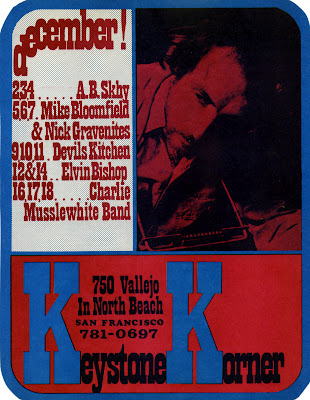
Keystone Korner, 750 Vallejo Street, San Francisco, CA

Keystone Korner wall mural by Josie Grant
 "The bar was owned by and named after Dino Pettuchi and Carlo Morrela. It was managed by Lou 'the Glue' Marcelli[1] who is still well known to patrons of the Dolphin Club in San Francisco. He is known as 'The Commodore'
This period of time was an exceptional fertile period in the development of rock and acid rock music. Dino and Carlo's showcased new musical groups, poets and artists. While serving pitchers of dark beer in an even darker environment, the bar allowed many new and up and coming bands to play their music. The beer was cheap. The performers were never paid. They put a hat on the front of the small stage to earn some compensation for their performance. The acoustics were terrible. The clientele included longshoreman and flower children, not necessarily a good mix. No one ever complained because the performances were outstanding.With the success of the San Francisco establishment, Dino and Carlo expanded and booked time at the Muir Beach Lodge in Marin County. They parlayed the success of a local disk jockey affectionately known as "The Buddha from Muir Beach" who already ran concerts at the Lodge. They renamed the Lodge to "The Dino and Carlo Naval Base"[2] and many of the same bands played both in San Francisco and Muir Beach"[22]

"I walked in. It was small. It was dark," she says of her first visit. "Everything was focused on the stage, because you could barely see anything else, and I just felt like I was home."[2]Located on a ground floor on Vallejo Street, off Columbus Avenue, in what is now a Chinese restaurant called Little Garden, Keystone Korner was said to be named for the "Keystone Cops" at the Central Police Station on the opposite corner of Emery alley.Owner Freddie Herrera was sleeping in his station wagon parked in the alley in back and his wife worked as the club's only topless dancer when an enebriated Nick Gravenites, songwriter, raconteur, and bon vivant, wandered into the off-the-beaten-path, dingy Keystone Korner in 1969. "What you need is some music, " he told Herrera. "I'll bring my friends down next weekend." With his topless bar operating four blocks away from the action on Broadway, Herrera wasn't having any luck attracting patrons than the previous owners, who named the place Dino Carlo's, had when they tried their hand at booking rock music and failed. Herrera, who didn't know Gravenites from Adam, agreed and had no idea that his "friends" would turn out to be superstar guitarist Mike Bloomfield and most of the recemnly disbanded Electric Flag, who packed the joint to the walls and beyond every weekend under the name Mike Bloomfield and Friends.
Another one of Gravenites friends, Elvin Bishop, recently departed Paul Butterfield Blues Band, was putting together his own group and looking fo a place to play. Herrera gave him Monday nights and served free fried chicken to the crowd. The place was packed every Monday night and Bishop delighted in hosting freewheeling jam sessions. A 16 year old guitar whiz from the Peninsula made his way up onstage one night, that's how Neal Schon first splashed down on the SF music scene (he later joined Santana and helped form Journey). The Pointer Sisters, preacher's kids from Oakland, started out singing background vocals with Bishop on Monday nights.[1]
In 1972 the club was sold to Todd Barken and immediately became a hit jazz spot featuring most of the big names of the times. He had a concept for a "bona fide psychedelic jazz club," and it limped from benefit to benefit, including one to buy a liquor license, through the '70s and into the '80s.[2]
Josie Grant did the portrait of Stan Getz as he stood outside playing his sax and also did the interior mural.
Fred Brayman-behind the stage artwork.
Daniel  Goldberg did the exterior art.
During the 1970's, when jazz clubs all over America were folding under the onslaught of rock and roll and disco, San Francisco’s Keystone Korner was an oasis for jazz musicians and patrons. Tucked next to a police station in the city’s North Beach area, the Keystone became known as one of the most important jazz spots in the United States. It was so beloved by musicians that superstars McCoy Tyner, Freddie Hubbard, Ron Carter, and Elvin Jones played a benefit concert just so the club could buy a liquor license.
Until his untimely death, one artist who frequently brought his artistry to the club throughout the 70's was jazz titan, Rahsaan Roland Kirk. Witness the great, 'Bright Moments' LP, a magical moment in recorded music that transpired within the boundaries of the Keystone's darkly painted walls and just in front of the golden mandala that forever framed the musicians on stage. The Keystone became the 'Kornerstone' for 'Bright Moments,' as countless hours of extraordinary music were created on that tiny stage, much of it released commercially. Although disputable, I might go as far as stating that it's quite possible Keystone Korner has hosted more jazz history within its confines than any other jazz venue on the West Coast of America.
Though the club came 10 or 20 years too late to get the greats in their prime, it got them on the way back down. Miles Davis, Chet Baker, Stan Getz, Dexter Gordon, Art Blakey and Bill Evans all played weeklong gigs there.[2]
"Keystone Korner, I believe, was the last of its kind, certainly on the West Coast, and maybe the East Coast except for the Village Vanguard," says Sloane, 71. "It was not a small concert hall, the way I think of Yoshi's. It was a club. It was relaxed. People could go backstage and talk to the musicians, the musicians would come out front. The distance between performers and audience was totally permeable."[2]
When Keystone closed in 1983, it was one of the last San Francisco clubs to regularly book national and international touring jazz groups.
Today, 2011, it's a hair salon.


Miles Davis is on the wall marquee

Until his untimely death, one artist who frequently brought his artistry to the club throughout the 70's was jazz titan, Rahsaan Roland Kirk. Witness the great, 'Bright Moments' LP, a magical moment in recorded music that transpired within the boundaries of the Keystone's darkly painted walls and just in front of the golden mandala that forever framed the musicians on stage. The Keystone became the 'Kornerstone' for 'Bright Moments,' as countless hours of extraordinary music were created on that tiny stage, much of it released commercially. Although disputable, I might go as far as stating that it's quite possible Keystone Korner has hosted more jazz history within its confines than any other jazz venue on the West Coast of America.

When Keystone closed in 1983, it was one of the last San Francisco clubs to regularly book national and international touring jazz groups.
Unknown photographer's shadow.
"Keystone Korner, I believe, was the last of its kind, certainly on the West Coast, and maybe the East Coast except for the Village Vanguard," says Sloane, 71. "It was not a small concert hall, the way I think of Yoshi's. It was a club. It was relaxed. People could go backstage and talk to the musicians, the musicians would come out front. The distance between performers and audience was totally permeable."(2)
Today, 2011, it's a hair salon.

11/25/70 New Riders Of The Purple Sage[24]
This may have been Spencer Dryden's warmup gig.
The first Garcia gig at a Freddie Herrera owned club.

3/25/71 Merl Saunders[9]
4/1/71 Merl Saunders[14]
5/20/71 Merl Saunders
5/21/71 Merl Saunders
5/22/71 Merl Saunders
5/25/71 Merl Saunders
Nutty Bumpo opened.[13]

5/26/71 Merl Saunders
Liquid Heart opened.

6/12/71 New Riders Of The Purple Sage[15]
The Rowan Brothers opened.

6/13/71 New Riders Of The Purple Sage(15]
The Rowan Brothers opened.

6/15/71 Merl Saunders[15]
6/16/71 Merl Saunders[15]
7/10/71 Merl Saunders
7/11/71 Merl Saunders
8/11/71 Merl Saunders
8/12/71 Merl Saunders
8/18/71 Merl Saunders
9/1/71 Merl Saunders
9/16/71 Merl Saunders
10/8/71 Merl Saunders
10/9/71 Merl Saunders
10/15/71 Merl Saunders
"Merl, Tom Fogerty, Dave Getz (presumably) and John Kahn gigging at the Keystone Korner on a Friday-Saturday night in October, 1971 when Jerry is not known to have been otherwise occupied. Jerry and Merl were billed at the same place the weekend before. It was listed in the Hayward Daily Review, 1971-10-14, pg. 36."[8]

10/16/71 Merl Saunders[7]
Same as above

1/6/72 Merl Saunders[16]
1/7/72 Merl Saunders
Bill Kreutzmann on drums.[10]
"The tables and aisles were packed with people, and the doorman was busily and regretfully rejecting prospective customers."[10]

1/8/72 Merl Saunders[16]

1/14/72 Merl Saunders
1/15/72 Merl Saunders
"After the song, Save Mother Earth, a little kid, maybe 4 or 5 by the sound of it, exclaims, "I don't know about that!" A woman (presumably his Mom) repeats the exclamation as a query and chuckles. It's awesome. The kid's mind has been blown, he's not sure what to make of it (and in any case he occupies that deeply psychedelic realm known as the child's mind), and he can't contain himself. The fact that he's there at all, one of the relatively few (less than about 300, which was about the capacity of the KK), is pretty neat all by itself."[4]

1/28/72 Merl Saunders
This show was canceled.

1/29/72 Merl Saunders
This show was canceled.
Jerry performed with Howard Wales at New Century Theater, 511-513 Main Street, Buffalo, NY on this date.

2/3/72 Merl Saunders
Geoffrey, an escape artist may have opened.[17]

2/4/72 Merl Saunders
Geoffrey, an escape artist, may have opened.[17]

2/5/72 Merl Saunders
2/25/72 Merl Saunders, Armando Peraza[18]
2/26/72 Merl Saunders, Armando Peraza[18]
3/3/72 Merl Saunders
3/4/72 Merl Saunders
3/8/72 Merl Saunders, Armando Peraza
3/9/72 Merl Saunders, Armando Peraza[19]
3/10/72 Merl Saunders, Armando Peraza
3/11/72 Merl Saunders, Armandp Peraza[20]
3/15/72 Merl Saunders, Armando Peraza
3/16/72 Merl Saunders, Armando Peraza[19]
3/17/72 Merl Saunders, Armando Peraza
3/18/72 Merl Saunders, Armando Peraza[20]
6/6/72 Merl Saunders[11]
6/7/72 Merl Saunders[11]
6/8/72 Merl Saunders[11]

6/30/72 Merl Saunders
Owner Freddie Herrera's last show here.[6]
Paul Butterfield sits in for the last 40 minutes.[12]
The last night under Freddy Herrera's ownership the Merl Saunders-Jerry Garcia-Tom Fogerty quintet played to a house packed four deep to the wall. The basement dressing room echoed the nature of the evening. Nick Gravenites, who help Freddy book the club when it first opened, was there. So was Paul Butterfield, sporting a new full beard. The air was heavy with dope and conversation. "What a lot of freaks", said Jerry Garcia, fumbling for another joint in his coat pocket.[12]

7/7/72 Merl Saunders
7/8/72 Merl Saunders[5]
9/1/72 Merl Saunders

Keystone Korner, San Francisco, CA
1.)^Sloan, Kathy, “Keystone Korner: Portrait of a Jazz Club”
2.)^Whiting, Sam, 2011-10-10, "Keystone Korner" documents jazz club, http://www.sfgate.com/entertainment/article/Keystone-Korner-documents-jazz-club-2327672.php
3.)^Opening Today, 1970-11-25, San Francisco Chronicle, pg. 35, http://jgmf.blogspot.com/search/label/1970
4.)^2010-02-10, JGMS: the show known variously as 1972-06-30, 1972-09-01, 1971-09-01, http://jgmf.blogspot.com/2010/01/jgms-show-known-various-as-1972-06-30.html, 2010-01-10.
5.)^Barkan, Todd, comments, 2010-02-10, JGMS: the show known variously as 1972-06-30, 1972-09-01, 1971-09-01, http://jgmf.blogspot.com/2010/01/jgms-show-known-various-as-1972-06-30.html, 2010-01-10.
6.)^Troy, Sandy, pg. 153, RN Sandy Troy's Captain Trips (1994), 2013-12-28, http://jgmf.blogspot.com/2013/12/rn-sandy-troys-captain-trips-1994.html
7.)^Possible Jerry Gig? October 15-16, 1971, Keystone Korner, SF, CA, 2010-01-02, http://jgmf.blogspot.com/2010/01/so-heres-one-that-caught-my-eye.html
8.)^Possible Jerry Gig? October 15-16, 1971, Keystone Korner, SF, C, 2010-01-02, http://jgmf.blogspot.com/2010/01/so-heres-one-that-caught-my-eye.html
9.)^Wasserman, John L. 1971. On the Town: Some Travesties in the Music Biz [Something Else]. San Francisco Chronicle, March 24, 1971, p. 42., New to The List, 2013-05-12, http://jgmf.blogspot.com/2013/05/new-to-list.html
10.)^Hunt, Dennis, Guitarist Garcia Never Stops, 1972-01-10, san Francisco Chronicle, pg. 42.
11.)^Hunt, Dennis. 1972a. Guitarist Jerry Garcia Never Stops. San Francisco Chronicle (Jaunary 10), p. 42,  JGMS: January 6-7-8, 1972, Keystone Korner, 2014-08-03,  http://jgmf.blogspot.com/
12.)^Selvin, Joel, Jamming for the Hell Of It, 1972-09-27 to 10-03, The Night Times, Vol. 2, No. 20 (Issue 29)
13.)^Something Else, San Francisco Chronicle,1971-05-24, pg. 42, Joseph Jupille Archives.
14.)^Berkeley Barb, Vol. 3, No. 28, 1971-04-01, pg. 8, Joseph Jupille Archives.
15.)^Berkeley Barb, 1971-06-11-17, pg. 8.
16.)^New Wave in Erotographic Films, On The Town, San Francisco Chronicle, 1972-01-05, Joseph Jupile Archives.
17.)^Hayward Daily Review, 1972-02-03, Joseph Jupille Archives.
18.)^Musical happenings In The Bay Area, San Francisco Chronicle, 1972-02-25, pg. 43, Joseph Jupille Archives.
19.)^The Night Times, 1972-02-03, pg. 6, Joseph Jupille Archives.
20.)^Music, The Night Times, 1972-03-6-21, pg. 5, Joseph Jupille Archives.
21.)^May, Merideth, San Francisco Chronicle, 2011-06-06.
22.)^Personal letter from Lou Marcelli to Ron Small.


Tuesday, December 18, 2012

UIC Pavilion (University Of Illinois), 525 S. Racine, Chicago, Illinois


Capacity 10,075
Opened on May 31, 1982 at a cost of $10 million. The architect was Skidmore, Owings and Merrill. It is home to the University of Illinois at Chicago Flames basketball team and the Windy City Rollers.
         It was renovated in 2001. When used as a concert venue the arena seats up to 10,075 for end stage shows, 7,924 for 3/4-house shows, and 5,878 for 1/2-house shows.


Jerry performed here on
8/18/84 JGB
4/9/87 Grateful Dead
4/10/87 Grateful Dead
4/11/87 Grateful Dead

1.)^Circle Builds A Giant, 81-06-09, Chicago Tribune

Monday, December 17, 2012

Tower Theatre, 19 S. 69th Street, Upper Darby, PA


Capacity 3119
William Friehofer had been building theaters for decades before taking on 69th street. This was the largest theater he would build. Built in 1927 as a movie and vaudeville showplace, the Tower Theater was reborn in the 1970's as a premier venue for concerts. The Tower Theater was opened in 1928 by John H. McClatchy as one of Upper Darby Township's first movie houses.
A high, steel tower has loomed above the landscape at 69th and Ludlow streets since 1927. Evocative of the old RKO Pictures logo, the structure initially was topped off with a swirling, illuminated ball that could be seen for miles, and gave the Upper Darby showplace beneath it, the Tower Theater, its name.
Today, virtually all the other ornate "photoplay" (movie) and stage-show palaces of the Tower's size (originally 2,616 seats, now 3,119) and elegance are gone. And, sadly, that attention-grabbing light fixture no longer functions.

"Just one year before the Great Depression, the Tower went up in record time. The 3500 seats were installed in five days, a fact the Stone Company (the seat manufacturer) was very proud of. At the time of the grand opening the builder, George Kessler Co. had been a leader in theater construction for 50 years.

In the 1930's and 40's with Vaudeville on the way out, movies slowly became the main attraction at the Tower on 69th Street, and in the 50's and 60's the Tower presented first run movies and live events with a class and style unequaled by other theaters".


The lobby, with its 25 foot marble style ceiling, had the largest Oriental rug in the area covering the marble and Caen stone floor. The foyer was lavishly furnished with couches and chaise lounges. In the basement were smoking lounges for both men and women done in an Italian style with wood beams overhead. The lighting in the foyer and lobbies was constantly changing colors. 135 miles of wire ran through the building to the largest dimmer board in the country (at the time), With a capacity of 3500 seats, the Tower Theater was, and still is, one of the largest theaters in the region.

It was then owned by the A.M. Ellis chain and showed third-run movies for a $1 admission.
The 70's ushered in a new era to Upper Darby... the Rock Concert.
In 1972 Philadelphia music fans discovered the near perfect acoustics of the stately 69th Street movie house. Dave Mason was the first to headline. The support act on opening night was Buzzy Linhart. Buzzy said it all when he stopped in the middle of his set and told the crowd this place has more class than the Fillmore ever had!
For the next three or more years, Midnight Sun's Tower concerts became the stuff of local legend. The Tower introduced America to David Bowie and The Spiders from Mars in 1972 as well as the then-unknown Genesis with Peter Gabriel that same year; Genesis played a midnight concert with a $4 admission price. In September 1974, Bruce Springsteen – who had an early, strong, and long-lived fan base in Philadelphia – introduced the world to his new E Street Band, with Max Weinberg and Roy Bittan, at the Tower Theater.
Photo courtesy of infotaupe.blogspot.com
It was the first time in his career that Springsteen earned $5,000 for a night's work. He returned in early November for two sold-out shows; it would still be a year before his big breakthrough with Born to Run and the attendant publicity. Other regular Midnight Sun headliners at the Tower included Jackson Browne, Lou Reed, Steve Miller, and various editions of the Jerry Garcia/Merle Saunders band. David Bowie repaid his Philly fans by recording his David Live album during a long run of shows at the Tower. The Average White Band's live album, Person to Person, was recorded at the Tower with Atlantic Records' Arif Mardin in the production truck behind the theater.

In late 1975, the owners informed Midnight Sun that they were selling the theater to the promoter's much larger competitor, Electric Factory Concerts. The final Midnight Sun produced show at the Tower was 10cc, the British pop duo, in December 1975.

A well-regarded 1980 show at the theater became the source for the video Paul Simon in Concert, released in 2003 as Live at the Tower Theatre.

The Tower Theater happened to be a popular venue for Berliner's Tangerine Dream since they played here 4 times on their North American Tours. Dates include April 6, 1977; June 25, 1986; September 10, 1988; and October 10, 1992.

By the 2000s the theater continued to be active, filling much the same role in the concert hierarchy as the Beacon Theatre in New York City. The theater operates under the Live Nation/Electric Factory Concerts name.(1)


The lobby will soon have its 25 foot high dome again. A drop ceiling will be removed to reveal once again this magnificent feature of the Tower Theater.

Jerry performed here on
11/16/74 early and late shows Merl Saunders
(Early) That's The Touch I Like, Expressway;He Ain't Give You None;You Can Leave Your Hat On;Valdez In The Country;Going Going Gone;Second That Emotion 
(Late) It Takes A Lot To Laugh It Takes A Train To Cry;Favela;My Problems Got Problems Mystery Train>La-La;People Make The World Go Round;Money Honey;The Harder They Come;The Night They Drove Old Dixie Down
Promoter Midnight Sun/Rick green

4/11/75 early and late shows Legion Of Mary
(Early) Tore Up Over You;Favela;I Feel Like Dynamite;Last Train From Poor Valley;Tough Mama;Mystery Train>Expressway;People Make The World Go Round;Second That Emotion;The Night They Drove Old Dixie Down 
(Late) The Harder They Come;You Can Leave Your Hat On;Soul Roach;Wicked Messenger,;Money Honey;Mississippi Moon;Boogie On Reggae Woman;I'll Take A Melody;How Sweet It Is
Promoter Midnight Sun
Attendance for early show-2236 
Attendance for late show-2792

10/31/75 early and late shows Jerry Garcia Band
(Early) Sugaree, That's What Love Will Make You Do, Sitting In Limbo, Every Word You Say, All By Myself, Tough Mama, Pig's Boogie, They Love Each Other, Mississippi Moon, Mystery Train 
(Late) Let It Rock;Tore Up Over You;Russian Lullaby;Friend Of The Devil;It's Too Late, Lady Sleeps>No Time;Money Honey;Positively 4th Street;How Sweet It Is;The Night They Drove Old Dixie Down;Let's Spend The Night Together>Edward The Mad Shirt Grinder
Ron Tutt on drums.[11]
Promoter Midnight Sun.
Late show-"At the beginning of the set Nicky Hopkins came out on stage with a wizard's hat on and a broom and ran around the stage on it (Jerry seemed mildly annoyed).
Also, Jerry played slide for the last number (Edward the Madshirt Grinder). In the middle of his slide solo, he abruptly stopped and walked off the stage, ending the show."[6]

6/21/76 Grateful Dead
I:The Music Never Stopped;Sugaree;Mama Tried;Brown Eyed Women;Cassidy;Row Jimmy;Looks Like Rain;Scarlet Begonias;Lazy Lightnin'> Supplication;Candyman;The Promised Land
II:The Wheel;Samson And Delilah;Help On The Way>Slipknot!>Franklin's Tower;Dancing In The Street;Wharf Rat>Around And Around;It Must Have Been The Roses
Encore:Johnny B. Goode
https://archive.org/details/gd1976-06-21.sbd.digitalrbb.miller.112171.flac16

6/22/76 Grateful Dead
I:U.S. Blues;The Music Never Stopped;Crazy Fingers>Comes A Time;Big River;Tennessee Jed;Looks Like Rain;They Love Each Other; Cassidy;Ship Of Fools;The Promised Land
II:Playing In The Band>Space Jam>Drums>The Wheel>Playing In The Band Reprise;Samson And Delilah;Eyes Of The World>Dancing In The Street;Around And Around>Goin' Down The Road Feeling Bad>One More Saturday Night
https://archive.org/details/gd1976-06-22.sbd.digitalrbb.miller.112218.flac16

6/23/76 Grateful Dead
I:The Music Never Stopped;Sugaree;Mama Tried;Row Jimmy;Big River;High Time;Looks Like Rain;Brown Eyed Women;Lazy Lightnin'>Supplication;Friend Of The Devil;The Promised Land
II:Samson And Delilah;Might As Well;Let It Grow >Drums>Let It Grow>Cosmic Charlie;Saint Stephen>Not Fade Away>Saint Stephen> Drums;Dancing In The Street>The Wheel.Johnny B. Goode
https://archive.org/details/gd1976-06-23.aud.miller.95321.sbeok.flac16
"The show actually started with a pretty long rendering of Bob Weir's nonsensical story of the Little Yellow Dog."[3]

6/24/76 Grateful Dead
I:Cold Rain And Snow;Big River;Friend Of The Devil;Cassidy;It Must Have Been The Roses;Lazy Lightnin'> Supplication;Tennessee Jed;Looks Like Rain;Scarlet Begonias;The Promised Land
II:Help On The Way>Slipknot!>Franklin's Tower>Samson And Delilah;Wharf Rat>Jam>Dancing In The Street;Sugar Magnolia
https://archive.org/details/gd76-06-24.set2-sbd.wiley.14498.sbeok.shnf
WMMR FM broadcast 

11/25/77 Jerry Garcia Band
(Early) How Sweet It Is;Catfish John;Sitting In Limbo;That's What Love Will Make You Do;Knockin' On Heaven's Door;Mystery Train;Mission In The Rain,
(Late) The Way You Do The Things You Do;They Love Each Other;Second That Emotion;Russian Lullaby;Midnight Moonlight;Gomorrah;Rubin And Cherise;The Night They Drove Old Dixie Down;Lonesome And A Long Way From Home
 Promoter Electric Factory.
"The November 1977 Tower Theater shows, both are great, first is mind blowing...I remember watching Jerry and getting the feeling that he was thinking "so, you came to see me play guitar, watch this" and he just went off....I used to have these types of mind connections with him all the time. Even when I was way back and out of the action so to speak or up close I felt that Jerry ALWAYS knew I was there...I was pretty naive to think I had a psychic connection with someone I never met. Until after the California theater show in San Diego in 86 I knew I had been right all along when Jerry went into "Lonesome and a Long Way From Home" and was looking at ME over his glasses the way he did the whole time...My first Non east coast Dead event( I was there alone) and he played that song for me. He knew when WE were in the house, all of US. That's what kept us coming back, was that feeling they were playing for us and that we were their motivation. I know I know I am still naive to believe that, but I do…"[2] 
2/23/80 early and late shows Jerry Garcia Band
(Early) Catfish John;How Sweet It Is;Friend Of The Devil;That's What Love Will Make You Do;Postively 4th Street;That's Alright Mama 
Encore:Deal
(Late) Sugaree;The Harder They Come;Russian Lullaby;Tore Up Over You;Midnight Moonlight 
Encore:When I Paint My Masterpiece 
Robert Hunter opened.
"Substituting for Rachel Sweet, who has postponed her tour, Robert Hunter offered a short but enjoyable set."[12]

“Throughout the set, Garcia played with enthusiasm and even jumped about during a few of the peak sequences.”[

2/6/81 Jerry Garcia Band
I: Knockin' On Heaven's Door;How Sweet It Is;Mississippi Moon;Mission In The Rain; Tangled Up In Blue 
II: The Harder They Come;They Love Each Other;Tore Up Over You;I'll Take A Melody; Midnight Moonlight 
Encore:Dear Prudence

10/31/81 early and late shows Jerry Garcia Band
(Early) How Sweet It Is;Catfish John;That's What Love Will Make You Do;Simple Twist Of Fate;Knockin' On Heaven's Door, Roadrunner;Deal;Tangled Up In Blue 
(Late) The Way You Do The Things You Do;They Love Each Other;Valerie;I'll Take A Melody;Russian Lullaby;The Night They Drove Old Dixie Down;Dear Prudence 
Encore: Sugaree
Peter Rowan opened.
Promoter Electric Factory/Monarch Entertainment Presents.[13]
5,960 tickets sold.[7]

6/27/82 early and late shows John Kahn (acoustic)
(Early) Deep Elem Blues;Dire Wolf;Friend Of The Devil;Valerie;Oh Babe It Ain't No Lie; Little Sadie;It Takes A Lot To Laugh It Takes A Train To Cry;Run For The Roses 
Encore:Ripple 
(Late) Deep Elem Blues;I've Been All Around This World;Jack-A-Roe;Bird Song;Sing Me Back Home;Gomorrah;Oh Babe It Ain't No Lie;Run For The Roses;Ripple 
Encore:Dire Wolf
John Hammond opened.
Promoter Electric Factory/Monarch Entertainment.[14]
Attendance early show-2,869[8]
Attendance late show-2869[14]

11/7/82 early and late shows Jerry Garcia Band
(Early) How Sweet It Is;They Love Each Other;Second That Emotion;Valerie;Mystery Train;Love In The Afternoon;Dear Prudence;Deal 
Encore:Run For The Roses 
(Late) How Sweet It Is;Catfish John;Mission In The Rain;Simple Twist Of Fate;Let It Rock; Run For The Roses;The Night They Drove Old Dixie Down;Tangled Up In Blue 
Encore:Midnight Moonlight
John Hammond opened.[17]
Promoter Electric Factory/Monarch Entertainment
Attendance early show-3,004 tickets sold.[9]
Attendance late show-3004[15]

6/5/83 early and late shows Jerry Garcia Band
(Early) Cats Under The Stars;They Love Each Other;Let It Rock;Love In The Afternoon; Second That Emotion;Simple Twist Of Fate;Run For The Roses 
Encore:Rhapsody In Red 
(Late) How Sweet It Is;I'll Take A Melody;Cats Under The Stars;Gomorrah;The Harder They Come;Dear Prudence;Tangled Up In Blue 
Encore:Midnight Moonlight
Electric Factory Presents.
"I remember seeing an announcement on the Spectrum scoreboard at my first Grateful Dead show, April 25, 1983, that the Jerry Garcia Band was playing at the Tower in June.  It got a round of applause and my interest.  Later that Spring I grabbed a friend, my older sister (who could drive, I wasn’t old enough to drive!) and she brought a friend and we departed the hour plus to the Tower. Drank Schlitz Malt Liquor Bull on the way down, we weren't quite as enlightened about drinking local (and good) as we are now.  I distinctly remember playing Workingman’s Dead from a boom box on the way down and my sister and her friend becoming a tad aggravated at the “long” jam during Easy Wind.  I told her she better get used to it because that’s what this concert is going to be about.  There was a noticeable silence after that like “what did we get into.”
After a few bulls in the parking lot we rolled in for the early show.  I remember some women trying to get me to donate to a cause.  I had no money for them but they gave me a button anyway.  Our seats were about half or 3/4th back and the show was not full.  There was an awful opening band… they played a sort of pop punk that was popular at the time and had female singers.  One song in particular was bad where they would just shout the words “fresh fruit!” during a musical break in the song. That became a running joke for my sis and I for years afterwards.  I wonder if anyone remembers that?  Anyway, regarding Garcia’s band I didn’t really know any of the songs except, vaguely, Run for the Roses (at least it sounded familiar) as I was a concert neophyte but that was to change, and I already had my tickets to see the Dead at City Island later that month.  Those were the days when you could see Jerry about every other month on the east coast outside of the winter!  I remember thinking the backup singers were kind of cool, and added a nice dimension.  I probably thought the show seemed short but I know I didn’t care much, as it was an event and a great time.  I think it was still light when we left the theatre and the late show crowd was waiting outside!"[4]

12/2/83 Jerry Garcia Band
I: How Sweet It Is;I'll Take A Melody;Someday Baby;When I Paint My Masterpiece; Mississippi Moon;Deal 
II: The Harder They Come;Gomorrah;Cats Under The Stars;Run For The Roses;Tangled Up In Blue
Promoter Electric Factory-Allan Spivak
"I had a friend who had gotten in with Jerry by hanging with some people who use to go to the Navarro in NYC and party with the band. He had always said that he would take me up to meet Jerry at some point and this was the night.  We actually didn't see him until the next morning, after the show my friend would call him at the hotel and Jerry would say call back in a while and it finally got so late that we went home and drove back up in the morning to see him.  Spent about 90 minutes with him in his room, hotel off Rittenhouse Square (can't remember the name).  I had met him briefly before a Garcia Band show in Davis CA in '76 so I wasn't a pure virgin but it was still pretty cool, even though we were tired from partying too much the night before.
One of the things my friend made a point of saying was "Don't talk about the Dead", which I kind of already knew and of course makes sense, last thing he wants to talk about.  Jerry was into UFO's and so was my friend so that's what we spent most of the time talking about.  He claimed that he and Laird Grant saw a car with no wheels floating down the street one day and had a few other funny stories.  I had noticed that the second set the night before was a little low energy and he said that he had had a stomach ache.  Also, Dylan's "Infidels" album had just come out and I had made a cassette copy for him that I gave him for the bus.  I commented that he should do Sweetheart Like You (he could have killed that song) and he said that he was actually considering it but of course it never happened so maybe he was just being polite.
The one thing that really stood out to me was how friendly he was and comfortable he made me feel.  He didn't know me from Adam but he went out of his way to put me at ease.  Also, he looked you straight in the eye when he talked to you and in an incredibly friendly way.  I remember thinking that if I was in a room with Mick Jagger or David Bowie that there was no way I would feel this comfortable.  He also looked shorter in person then I expected, but he was big, it was '83 after all and he wasn't in the best shape."[5]

11/21/84 Jerry Garcia Band
I: Deep Elem Blues;Friend Of The Devil;I've Been All Around This World;Simple Twist Of Fate 
II: Run For The Roses;Jack-A-Roe;Gomorrah;Bird Song;Goodnight Irene
Robert Hunter opened.
Promoter Electric Factory Presents.

1/25/86 John Kahn (acoustic)
I: It Takes A Lot To Laugh It Takes A Train To Cry;Little Sadie;Oh Babe It Ain't No Lie; Deep Elem Blues;Simple Twist Of Fate;Run For The Roses 
II: Dire Wolf;Spike Driver Blues;Jack-A-Roe;Dire Wolf;Ripple 
Encore:Goodnight Irene
Jerry plays a Takamine guitar.
3,020 tickets sold.[10]

Tower Theatre, Upper Darby, PA
1.)^TOWER THEATER, http://www.philadelphia-theater.com/theaters/tower-theater/history.php
2.)^monster trout (Catchabigone)Bushinsky, Dave, Other Stuff comments, 2012-10-23, http://www.philzone.org/
3.)^Alan Sheckter,2011-06-22, http://www.dead.net/show/june-23-1976
4.)^Bednar, Jeff, comments, http://www.thejerrysite.com/shows/show/1708
5.)^Melvin, Tom, comments, http://www.thejerrysite.com/shows/show/1671
6.)^Keating, Terry, comments, http://www.thejerrysite.com/shows/show/1109
7.)^http://rocktourdatabase.com/concerts/jerry-garcia-band-19
8.)^http://rocktourdatabase.com/concerts/jerry-garcia-band
9.)^http://rocktourdatabase.com/concerts/jerry-garcia-john-hammond
10.)^http://rocktourdatabase.com/concerts/jerry-garcia-band-7
11.)^Lloyd, Rick, Legendary Garcia Performs at the Tower, The Villanovan, 1975-11-05, pg. 8, Joseph Jupille Archives.
12.)^Gutman, Barry, review, 1980-02-23, unknown publication, Joseph Jupille Archives.
13.)^Billboard, 1981-11-21, unknown page, Joseph Jupille Archives.
14.)^Billboard, 1982-07-17, unknown page, Joseph Jupille Archives.
15.)^Billboard, 1982-12-04, unknown page, Joseph Jupille Archives.
16.)^Gutman, Barry, Jerry Garcia Band, Review, Unknown publication, Joseph Jupille Archives.
17.)^Box Office, Billboard, 1982-12-04, pg. 36, Joseph Jupille Archives.

Sunday, December 16, 2012

Ken Babbs Spread, Soquel CA

Parallel to the commercial fortunes of The Warlocks, the band had been hanging out with Ken Kesey and his Merry Pranksters. In their new incarnation as The Grateful Dead, they had begun playing Acid Tests with the Pranksters (remember, LSD was legal until October 6, 1966). The band was unbilled, since The Acid Tests themselves were only cryptically advertised.(1)

11/27/65 Grateful Dead
"A poster for the first Acid Test at the Spread in Santa Cruz on Nov. 27, 1965 exists."(1)

1.)^http://www.postertrip.com/public/department37.cfm


Saturday, December 15, 2012

Fireside Lounge, 2322 El Camino Real, San Mateo, CA

The Fireside Lounge was run more on the Las Vegas model, if without the gambling. There was dinner and drinks to go with the dancing, sometimes a floor show, or topless dancers late at night. The object for a band was to keep people dancing so that they would buy drinks.(1)

8/65 The Warlocks
According to Dennis McNally and Blair Jackson in The Illustrated Trip, The Warlocks played one or a few gigs at The Fireside Lounge in August of 1965. It was probably a sort of "audition" gig.(1)

1.)^Arnold, Corry, Lost Live Dead, 2009-09-06, North To San Francisco, http://lostlivedead.blogspot.com/2009/09/north-to-san-francisco-warlocks-in.html

Ventura Counry Fairgrounds, 10 Harbor Blvd., Ventura, CA

The fairgrounds, originally deeded to the city of San Buenaventura by H.P. Foster in the 1800's, was then quit-claimed to the state back in the early part of the last century, taking it out of local control forever.(1)
Located on the beach in Ventura, site of the annual Ventura County Fair, Ventura County Fairgrounds is easy to find on US Hwy 101, only 30 miles from Santa Barbara and 60 miles from Los Angeles.
Rock history was made at the Ventura County Fairgrounds on July 21, 1970.
June 21, 1970
James Marshall “Jimi” Hendrix graced the stage at Ventura County Fairgrounds just two months before his untimely death on September 18, 1970 at age 27.
Hendrix generated a stir here in Ventura – as cops were called and fifteen were arrested for trying to crash the gates.
This  article from the Ventura County Star-Free Press, on July 22, 1970 reads,
“The Jimi Hendrix Experience rock concert drew an enthusiastic crowd of nearly 4,000 last night at the county fairgrounds in Ventura.  Another group of 400 youths tried to crash the gates for free entry and a small conflict between them and 80 policemen and sheriff’s deputies erupted.  The youths threw rocks and bottles at police; no one was hurt.  Fifteen were arrested for unlawful assembly.”(2)

"The venue itself was a large rodeo ring with raised covered bleachers on one side. When you passed the parking lot and through the gate single file, you had your choice of turning right into the ring (floor seats, so to speak), or left into the shaded bleachers. It became a habit for us to spend at least the first set in the shaded bleachers, as the vantage and scenery were great and one could watch every one of those hundreds of different Dead-shirts (commercial and home-made) as they walked into the arena and eventually reached seething critical mass at showtime. Behind us was the point and Pacific Ocean. To our right (southeast) was the Holiday Inn and parking lot and ocean. In front of us was the rodeo ring and a few small buildings, the train tracks and freeway, then the small town of Ventura petering up into the scrub hills. To the left was the stage at the end of the ring, behind which was palm trees, a train trestle over a lagoon, and ocean beyond that."(3)

In 2010, California Gov. Arnold Schwarzenegger, in an unprecedented move, announced a deal to sell the Ventura County Fairgrounds to Caruso Affiliated for $58 million dollars. The transaction was mentioned during a speech by the governor before real estate professionals in Sacramento.(1)


7/17/82 Grateful Dead
7/18/82 Grateful Dead
7/30/83 Grateful Dead
"...during "I Know You Rider": the Band, with a consistently strong breeze blowing back their hair (and greatly marring the sound quality of these recordings), behind whom arched palm trees framing a passing Northbound train on the hillside a few hundred yards back of stage, its headlamp lit, perfectly on cue."(4)

7/31/83 Grateful Dead
7/21/84 Grateful Dead
7/22/84 Grateful Dead
7/13/85 Grateful Dead
7/14/85 Grateful Dead
6/12/87 Grateful Dead
6/13/87 Grateful Dead
6/14/87 Grateful Dead
"They stopped Space 1/2 way through and all sang "Hey Hey we're The Monkee's, and people say we Monkee around!!" and then just resumed like nothing ever happened - a truly mind-melting freakout."(5)
"...during Wharf Rat this dude behind asked questions prior to every line Jerry sang, 'where'd ya go?' 'wandered downtown down to take look around'. 'who'd ya see?' Bonnie lee."(6)

7/31/92 Jerry Garcia Band
5/14/94 Jerry Garcia Band

1.)^Codarini, Joseph, Ventura County Fairgrounds sold to Caruso Affiliated, 2010-04-01, http://vcreporter.com/cms/story/detail/ventura_county_fairgrounds_sold_to_caruso_affiliated/7782/
2.)^Back In The Day in Ventura County 1970: Fifteen arrested at The Jimi Hendrix Experience Show at Ventura County Fairgrounds, http://www.ventura101.com/2011/09/25/back-in-the-day-in-ventura-county-1970-fifteen-arrested-at-the-jimi-hendrix-experience-show-at-ventura-county-fairgrounds/
3.)^jacksondownunda, comments, 2007-11-12, http://www.dead.net/show/july-17-1982
4.)^Joby, comments, 2004-07-12, http://archive.org/details/gd83-07-30.aud.dodd.11932.sbeok.shnf
5.)^richthephotog, comments, 2007-07-09, http://www.dead.net/show/june-14-1987
6.)^bolted, comments, 2011-01-27, http://www.dead.net/show/june-14-1987

Friday, December 14, 2012

Veteran's Memorial Coliseum (New Haven Coliseum), 89 George Street, New Haven, CT


Capacity 11171
The New Haven Coliseum was a sports-entertainment arena located in downtown New Haven, Connecticut. Construction began in 1968 and was completed in 1972.

The arena's formal name was Veterans Memorial Coliseum, but most locals simply referred to it as "the Coliseum."

The Coliseum was built to replace the New Haven Arena, New Haven's prior indoor sports and entertainment venue. The Coliseum, as well as the neighboring K of C building, was designed by the architects Kevin Roche / John Dinkeloo & Associates. One interesting aspect of the arena's design was that the parking garage was built on top of the actual Coliseum structure; this was necessitated by a high water table in the area which made it overly difficult to construct sub-surface parking facilities. Though an interesting solution, this design was not very popular in the marketplace because of the quarter-mile helical ramps required to access the parking. Other features of the design, such as street storefronts and an exhibition hall, were never completed.

Neil Young performed here on January 25, 1973.

During the 1980s, the structure of the parking garages had deteriorated to the point where large canvas panels had to be attached to the outside to catch pieces of concrete that would occasionally drop off onto the sidewalk below. Renovations were made to correct that problem. The city shut down the facility after concluding that it was a drain on city coffers. However, the city did not hold any public hearings, referendum votes, or conduct any surveys, and several groups, local stakeholders, and the Coalition to Save Our Coliseum mounted a campaign to save and renovate the Coliseum, to no avail. Others in the community supported the plan to demolish the arena. Despite Mayor DeStefano's plan to close and demolish the building within six months, it ultimately took more than four years.
Actual demolition work began in late October 2005 with removal of most of the arena area.

At 7:50 a.m. on January 20, 2007, after years of wrangling and delay, the Coliseum was finally imploded, using more than 2,000 pounds of explosive. It was said that the implosion could be heard all the way to Meriden and Northford.
As it came down, a massive cloud of dust and smoke covered the surrounding area, but blew away quickly toward the shoreline. Upwards of 20,000 people watched from the nearby Temple Street Garage and other buildings, and residents of nearby apartments were evacuated. The two helical ramps were not imploded, and were subsequently destroyed by conventional methods.
The city has tentative plans to replace the Coliseum with a new downtown/Long Wharf redevelopment plan,[2] including a relocated Long Wharf Theatre and a new campus for Gateway Community College.

A temporary 400-space parking lot opened on the former Coliseum site on December 4, 2007, but plans are advancing to redevelop the site with a mix of offices, apartments, and retail space.(1)

5/5/77 Grateful Dead (New Haven Coliseum)
5/10/78 Grateful Dead (New Haven Coliseum)
11/25/78 Grateful Dead
"Grateful Dead were set up at the Veteran's Memorial Coliseum in New Haven, CT on November 25, but Bob Weir and Mickey Hart had to come onstage and announce that Garcia was sick, and that the show would be rescheduled."(1)

1/17/79 Grateful Dead (New Haven Coliseum)
"This was the show they played to make-up the performance where everyone got in to the hall, and then Bobby announced that Jerry had pneumonia and couldn't play."(3)

10/25/79 Grateful Dead (New Haven Coliseum)
5/11/81 Grateful Dead (New Haven Coliseum)
5/12/81 Grateful Dead (New Haven Coliseum)
6/17/82 Jerry Garcia Band (Veteran's Memorial Coliseum)
9/23/82 Grateful Dead (New Haven Coliseum)
4/22/83 Grateful Dead (New Haven Coliseum)
4/23/83 Grateful Dead (New Haven Coliseum)
4/23/84 Grateful Dead (New Haven Coliseum)
4/24/84 Grateful Dead (New Haven Coliseum)

1.)^Arnold, Corry, 2012-11-01, Reconstructing Reconstruction, http://lostlivedead.blogspot.com/2012/11/reconstructing-reconstruction-january.html
2.)^Hanley, Rich, The true story of the New Haven Coliseum, revealed, http://www.lastdaysofthecoliseum.com/
3.)^gleng1, comments, 2007-06-18, http://www.dead.net/show/january-17-1979

Wednesday, December 12, 2012

Capital Centre (US Air Arena), 1 Harry S. Truman Dr., Landover, Maryland


Capacity 18,756
The Capital Centre (also briefly known as US Airways Arena and USAir Arena) was an indoor arena located in Largo, Landover, Maryland; a suburb of Washington, D.C. completed in 1973.
The Capital Center, which cost $18 million to build, was ahead of its time when the Wizards' majority owner, Abe Pollin, opened it for his N.B.A. and National Hockey League teams on Dec. 2, 1973. The architect was Shaver Partnership.

It was the first arena with luxury sky boxes and featured a four-sided replay screen suspended above the court,  known as the "Telscreen" (or "Telescreen") and predated the DiamondVision video screen at Dodger Stadium by seven years. It is now a standard feature in arenas. It was also the first arena to be built with a computerized turnstile system.

A boxing World Heavyweight Championship bout took place at the venue on April 30, 1976, with Jimmy Young challenging the champion Muhammad Ali. The fight went the full fifteen rounds and was awarded unanimously to Ali.

The Capital Centre was the first indoor arena to have a video replay screen on its center-hung scoreboard. The four-sided video screen was known as the "Telscreen" (or "Telescreen") and predated the DiamondVision video screen at Dodger Stadium by seven years. It was also the first arena to be built with luxury boxes and a computerized turnstile system.

The last time that Frank Sinatra & Dean Martin sang in concert together was at the arena.
Bob Dylan and The Band (Robbie Robertson, Rick Danko, Garth Hudson, Richard Manuel and Levon Helm) played two nights on Dylan's return tour on January 15 and 16, 1974.
Eric Clapton, REM, Bruce Springsteen and David Bowie have also all performed major concerts at the venue.

The Rolling Stones played three sold-out shows at the arena on December 7-9, 1981.
Pop superstar Michael Jackson performed four concerts at Capital Centre on October 13, 17, 18 and 19, 1988 during his Bad Tour.

The Centre also had one of the NBA's most notorious fans, Robin Ficker, who for twelve seasons sat behind the visiting team's bench and heckled opposing players.
t was renamed for corporate sponsor US Airways in 1993, but reverted back to its original name of Capital Centre after the airline dropped its naming rights. The venue's name is also sometimes written as Capital Center, Capitol Center, Capitol Center Arena or Capital Center Arena. The venue closed in 1997.

Acting in his role as part-owner of the Washington Wizards' parent company, Michael Jordan and local officials unveiled plans to tear down the 27-year-old Capital Center and replace it with a retail and entertainment complex.
''I've had some great games in the Capital Center,'' said Jordan, who joined the Wizards front office this season after winning six N.B.A. titles with the Chicago Bulls. ''But obviously it's going to a better use, now that the MCI Center is established.''

It was renamed for corporate sponsor US Airways in 1993, but reverted back to its original name of Capital Centre after the airline dropped its naming rights. The venue's name is also sometimes written as Capital Center, Capitol Center, Capitol Center Arena or Capital Center Arena. The venue closed in 1997 and was demolished. The building was imploded on December 15, 2002 to make way for The Boulevard at the Capital Centre, a town center-style shopping mall.


7/29/74 Grateful Dead
9/25/76 Grateful Dead
11/23/78 Grateful Dead
11/8/79 Grateful Dead
8/31/80 Grateful Dead
9/27/81 Grateful Dead
9/15/82 Grateul Dead
9/11/87 Grateful Dead
9/12/87 Grateful Dead
9/13/87 Grateful Dead
9/2/88 Grateful Dead
9/3/88 Grateful Dead
9/5/88 Grateful Dead
9/6/88 Grateful Dead
3/14/90 Grateful Dead
3/15/90 Grateful Dead (Phil Lesh's 50th birthday)
"I had 1st row on the 16th. I had actually lost my tickets in the parking lot before the show but amazingly found them on the ground 20 min. later surrounded buy a large group of people needing a miracle!The tickets had been run over, stepped on,ground in the dirt,but nobody bothered to look in the envelope."(1)
3/16/90 Grateful Dead
3/17/91 Grateful Dead
3/18/91 Grateful Dead
3/20/91 Grateful Dead
3/21/91 Grateful Dead
11/6/91 Jerry Garcia Band
11/7/91 Jerry Garcia Band
3/8/92 Grateful Dead
3/9/92 Grateful Dead
3/16/93 Grateful Dead
3/17/93 Grateful Dead
3/18/93 Grateful Dead
11/7/93 Jerry Garcia Band (USAir Center)
10/9/94 Grateful Dead (USAir Arena)
10/10/94 Grateful Dead (USAir Arena)
10/11/94 Grateful Dead (USAir Arena)

1.)^DeadCannoneer1861, comments, 2010-09-07, http://archive.org/details/gd1990-03-15.28293.sbeok.shnf

Tuesday, December 11, 2012

Universal Amphitheatre, 100 Universal City Plaza, Universal City, Los Angeles, CA


Capacity 6189
The Universal Amphitheatre is a theatre located in Universal City, California, USA. It was originally built in 1971 as an outdoor venue.

Opening in the summer of 1973 with a production of Jesus Christ Superstar, it was extended until cold weather forced the show to close.[1]

It is the third-largest theatre in California, behind the Shrine Auditorium and Nokia Theatre, two other Los Angeles venues. The theatre is best known for its acoustics and its sightlines, considered the best of any theatre in North America.
It's located right next to Universal Studios Hollywood and the popular Universal CityWalk.
Owned by MCA Inc. which owns Universal Studios.

In 1975, neighbors started to complain about noise booming into their nearby homes. MCA made acoustical modifications  such as a sound wall and stone block wall on the south side of the theatre.  More walls behind the doors, sound panels over the speakers and pads to cover empty seats. MCA worked hard to avoid lawsuits.
Donna Summer with President and Mrs. Gerald Ford, October 13, 1977, Universal Amphitheater, photographer unknown

Elton John, September 27, 1979 Universal Amphitheater, photographer unknown

At the end of 1979, Universal Amphitheater was at a crossroads. It was either going to get a roof, get out of the concert business are stay as it was.
MCA wanted to bulldoze three surrounding hills for  more movie making, tram route and tour parking.  The Regional Planning Commission approved the project but wanted the Amphitheater permanently enclosed.

Michael Jackson and Liza Minnelli at her concert, 1980, Universal Amphitheater, unknown photographer
Blues Brothers August 1, 1980, Universal Amphitheater. Not only was this the last night of the Blues Brothers 22 show summer tour, this is the LAST concert John played with the band before his untimely death. This was the ONLY time the band performed the cover of the Rascals hit, "Come On Up."

On stage that evening: John "Jake" Belushi, Dan "Elwood" Akyroyd, Steve "The Colonel" Cropper, Donald "Duck" Dunn, Matt "Guitar" Murphy, Paul "The Shiv" Shaffer, Steve "Getdwa" Jordan, Tom "Bones" Malone, Alan "Mr. Fabulous" Rubin, Tom "Triple Scale" Scott, "Blue" Lou Marini and Murphy Dunne.
Frank Sinatra, August 6, 1980, Universal Amphitheater, unknown photographer
The Amphitheater closed for remodeling in September 1980. John Denver and George Burns September 25-28, 1980 performed the last outdoor program at the Amphitheater.

Neil Young performed here on 1/22/83.

The facility was redesigned from the ground up. The venue is now enclosed.  The capacity increased to 6,200, no seat is more than 150 away from center stage. Each seat has been uphostered in theatrical style and all aisles are now carpeted. Venue will now be opened year round.
A roof had to be put on the Amphitheater because of redevelopment of 70 acres on the Universal City lot.  Without the roof, the theater would no longer be able to comply with county noise abatement standards.

August 24, 1989

In early 2005, naming rights were acquired by the Gibson Guitar Corporation.[2]

On December 6, 2011, it was announced that Gibson Amphitheater would be demolished to make way for The Wizarding World of Harry Potter themed area.[3]

6/29/73 Grateful Dead
6/30/73 Grateful Dead
7/1/73 Grateful Dead
5/22/89 Jerry Garcia Band
7/29/92 Jerry Garcia Band

1.)^Link, Tom (1991). Universal City-North Hollywood: A Centennial Portrait. Chatsworth, CA: Windsor Publications. p. 87.
2.)^http://www.calendarlive.com/music/78786,0,52956.location
3.)^Nakashima, Ryan (December 6, 2011). "Poof! Harry Potter park to appear in Hollywood". USA Today.

Monday, December 10, 2012

Dining Hall, Menlo College, 1000 El Camino Real, Atherton, CA

The Menlo School for Boys, at 50 Valparaiso Street in Atherton, had been formed in 1924, taking over a Military Academy on the same site.
In 1927, the Menlo School for Boys also formed Menlo College, which was a sort of junior college that prepared students to go straight into the upper division. Menlo College was and still is located at 1000 El Camino Real in Atherton.(1)

9/65 Warlocks
"My source had one other, peculiar, unique memory about the Warlocks playing Menlo College. She and a friend had the duty of writing down the lyrics to songs that the band wanted to learn, many of them Rolling Stones songs. One thing she recalled about the Menlo gig was that the band had learned the Rolling Stones song "Off The Hook"  (released in the US in February 1965 on the album The Rolling Stones Now). My source had carefully explained to Jerry Garcia that when Mick Jagger sang the lyrics "it's off the hook, " Jagger had mimed holding a telephone to his ear. Whether she knew that from having seen the Stones, or from some television appearance isn't quite clear.
Nonetheless, my source recalled Jerry not only singing "It's Off The Hook," but miming the telephone bit. He even smiled at her when he did it, to show he'd learned his part. How often the Warlocks played "Off The Hook" after that remains unknown, and I doubt Jerry mimed the phone much. But he did it once, at least."(1)
"It was in some sort of dining hall or "rec room," and that numerous tables had to be pushed against a wall to allow everybody to dance. Her memory was that the purpose of the show was probably to encourage Menlo College students to recommend The Warlocks for paying gigs at school dances."(2)

1.)^Arnold, Corry, Lost Live Dead, Menlo College, 2011-09-29, http://lostlivedead.blogspot.com/2011/09/september-1965-dining-hall-menlo.html
2.)^Arnold, Corry, Lost Live Dead, Summer 1965, 2011-09-16, http://lostlivedead.blogspot.com/2011/09/summer-1965-top-of-tangent-117.html

Sunday, December 9, 2012

The "other" Palladium, 53rd Street and Broadway, New York, NY

There was a second Palladium also. The Palladium Ballroom was a second-floor dancehall on 53rd Street and Broadway in New York City which became famous for its excellent Latin music from 1948 until its closing in 1966.

In 1950, the Palladium gained in stature because of the Big Three:
  • Tito Puente
  • Tito Rodríguez
  • Machito.
 The year 1950, started the mambo craze that eventually spread across the United States began at the Palladium. At the height of its popularity, the Palladium attracted Hollywood and Broadway stars, especially on Wednesday nights, which included a free dance lesson. Dance instructors such as "Killer Joe" Piro - who briefly served as master of ceremonies the Palladium - and Carmen Marie Padilla (later the poet Carmen M. Pursifull), would offer mass dance lessons for the huge crowds. Club-goers of the era report seeing Marlon Brando, George Hamilton and others there.
The popularity of Perez Prado's Mambo No. 5 (1952) was taking everyone by storm.

The Palladium became the place to be seen at. Different jazz musicians and celebrities would sit in and play with the Latin bands:
The Palladium was in close proximity to the jazz clubs on West 52nd Street: Birdland, The Onyx and CuBop City. Jazz saxophonist Wayne Shorter, who lived in the NYC area during the heyday of the Palladium Ballroom, composed a piece during the 1970s called "Palladium" while a member of the seminal jazz-fusion group Weather Report. The song appears on their Heavy Weather (album) and features a driving Latin Rhythm among other delights.

I thought it interesting that there were two Palladiums but Jerry never performed here.