Tuesday, October 16, 2012

City Lights Books, 261 Columbus Avenue at Broadway, San Francisco, CA

City Lights is a landmark independent bookstore and publisher that specializes in world literature, the arts, and progressive politics.


The site was a tiny storefront in the triangular Artigues Building located at 261 Columbus Avenue, near the intersection of Broadway in North Beach. Built on the ruins of a previous building destroyed in the fire following the 1906 earthquake, the building was designed by Oliver Everett in 1907 and named for its owners.


City Lights originally shared the building with a number of other shops. It gradually gained more space whenever one of the other shops became vacant, and eventually occupied the entire building.
 

Founded in 1953 by poet Lawrence Ferlinghetti and Peter D. Martin, City Lights is one of the few truly great independent bookstores in the United States, a place where booklovers from across the country and around the world come to browse, read, and just soak in the ambiance of alternative culture's only "Literary Landmark." Although it has been more than fifty years since tour buses with passengers eager to sight "beatniks" began pulling up in front of City Lights, the Beats' legacy of anti-authoritarian politics and insurgent thinking continues to be a strong influence in the store, most evident in the selection of titles.
The nation's first all-paperback bookstore, City Lights has expanded several times over the years; we now offer three floors of both new-release hardcovers and quality paperbacks from all of the major publishing houses, along with an impressive range of titles from smaller, harder-to-find, specialty publishers. The store features an extensive and in-depth selection of poetry, fiction, translations, politics, history, philosophy, music, spirituality, and more, with a staff whose special book interests in many fields contribute to the hand-picked quality of what you see on the shelves.
The City Lights masthead says A Literary Meetingplace since 1953, and this concept includes publishing books as well as selling them. In 1955, Ferlinghetti launched City Lights Publishers with the now-famous Pocket Poets Series; since then the press has gone on to publish a wide range of titles, both poetry and prose, fiction and nonfiction, international and local authors. Today, City Lights has well over two hundred titles in print, with a dozen new titles being published each year. The press is known and respected for its commitment to innovative and progressive ideas, and its resistance to forces of conservatism and censorship. All City Lights Publications that are currently available are proudly featured in the bookstore and on this website as well.
With this bookstore-publisher combination, "it is as if," says Ferlinghetti, "the public were being invited, in person and in books, to participate in that 'great conversation' between authors of all ages, ancient and modern." City Lights has become world-famous, but it has retained an intimate, casual, anarchic charm. It's a completely unique San Francisco experience, and a must for anyone who appreciates good books.

Both the store and the publishers became widely known following the obscenity trial of Ferlinghetti for publishing Allen Ginsberg's influential poem Howl and Other Poems (City Lights, 1956).  In 2001, City Lights was made an official historic landmark. City Lights is located at the nexus of North Beach and Chinatown in San Francisco.

In 1953, as Ferlinghetti was walking past the Artigues Building, he encountered Martin out front hanging up a sign that announced a "Pocket Book Shop." He introduced himself as a contributor to Martin's magazine City Lights, and told him he had always wanted a bookstore. Before long he and Martin agreed to a partnership. Each man invested $500.
Ferlinghetti in front of his shop


Soon after they opened they hired Shig Murao as a clerk. Murao worked without pay for the first few weeks, but eventually became manager of the store and was a key element in creating the unique feel of City Lights.[1] In 1955, Martin sold his share of the business to Ferlinghetti for $1000, and moved to New York and started New Yorker Bookstore, which specialized in cinema.

In 1971, Ferlinghetti persuaded Nancy Peters - who was working at the Library of Congress - to join in a project with him, after which she began full-time work at City Lights.[2] She said:
When I joined City Lights in 1971, and started working with Lawrence, it was clear that it had been very much a center of protest, for people with revolutionary ideas and people who wanted to change society. And when I first began working at the little editorial office up on Filbert and Grant, people that Lawrence had known through the whole decade of the '60s were dropping in all the time, like Paul Krassner, Tim Leary, people who were working with underground presses and trying to provide an alternative to mainstream media. This was a period of persecution, and FBI infiltration of those presses.[3]

In 1984, the business was in a financial crisis and Peters became a co-owner of it.[2] Ferlinghetti credits her for the subsequent survival and growing success of the business.[4] In 1999, with Ferlinghetti, she bought the building they worked in.[5]

In 2001, the San Francisco Board of Supervisors made City Lights an official historic landmark - the first time this had been granted to a business, rather than a building - citing the organization for "playing a seminal role in the literary and cultural development of San Francisco and the nation." It recognized the bookstore as "a landmark that attracts thousands of book lovers from all over the world because of its strong ambiance of alternative culture and arts", and it acknowledged City Lights Publishers for its "significant contribution to major developments in post-World War II literature."
On the wall at City Lights

The building itself, with its clerestory windows and small mezzanine balcony, also qualified as a city landmark because of its "distinctive characteristics typical of small commercial buildings constructed following the 1906 earthquake and fire." The landmark designation mandates the preservation of certain external features of the building and its immediate surroundings. Peters commented (referring to the effect of dotcom and computer firms), "The old San Francisco is under attack to the point where it's disappearing."[6]

By 2003, the store had 15 employees.[7] Peters estimated that the year's profits would be only "maybe a thousand dollars."[8]

In 2007, after 23 years as executive director, she stepped down from the post, which was filled by Elaine Katzenberger; Peters remained on the board of directors.[4] Peters said of her work at City Lights:
When I started working here we were in the middle of the Vietnam War, and now it's Iraq. This place has been a beacon, a place of learning and enlightenment.[4]
As of 2008, City Lights is a general bookstore, specializing in fiction and poetry, cultural studies, world history, and politics. It offers three floors of new-release hardcovers and paperbacks from all major publishers, as well as a large selection of titles from smaller, independent publishers. City Lights is a member of the American Booksellers Association.


Jerry performed here in
??/??/61 Robert Hunter, Alan Trist
"When they had a working car, they often would go up to San Francisco to wander around North Beach and soak up what was left of the Beat scenes at places like City Lights Books and the Coffee Gallery."(11)


1.)^Hubler, Shawn, "City Lights Illuminates the Past," Los Angeles Times, 5/27/03
2.)^Morgan, Bill, http://www.citylights.com/bookstore/?fa=books_tour
3.)^And The Beat Goes On, 2003-06-09, http://www.sfgate.com/entertainment/article/AND-THE-BEAT-GOES-ON-City-Lights-and-the-2611121.php
4.)^Lynell, George (2007), "City Lights Books", Los Angeles Times, 22 April 2007.
5.)^"City Lights: 50 candles", Chicago Sun-Times on findarticles.com, 22 June 2003.
6.)^ David, Simon (2001), "'Beat city' fights dotcom gold rush", Daily Telegraph, 19 June 2001
7.)^Lara, Adair (2003), "Literary Light", San Francisco Chronicle, 5 June 2003.
8.)^Hubler, Shawn (2003), "At 50, City Lights illuminates the past", Oakland Tribune/Los Angeles Times on findarticles.com, 15 June 2003.
9.)^Ferlinghetti, L & Morgan, B "The Beat Generation in San Francisco: A Literary Tour" City Lights Books, 2003
10.)^González, Ray (2003) "Tracing the public surface", The Bloomsbury Review, Vol. 23, #2, 2003.
11.)^Jackson, Blair, Garcia: An American Life, pg. 36.


    Monday, October 15, 2012

    Non Commissioned Officer's (NCO) Club, 1550 Minnesota Avenue, Tyndall Air Force Base, Panama City, FL 32403


    Jerry performed here in
    1964 Sandy Rothman
    "Jerry and I also drove down to Florida to visit Berkeley mandolinist Scott Hambly (another highly original and accomplished instrumentalist like Jerry, and a one-gig replacement for David Nelson in the Black Mountain Boys) while he was stationed at Panama City's Tyndall Air Force Base. I listened to the two of them picking as we played an impromptu show that Scott had arranged at the NCO club and thought that it would be hard to find two city-based bluegrass musicians better matched for sheer profusion of notes and ornamentation. A flock of notes flew with the airplanes over the warm Florida sands that night."(1)


    1.)^Rothman, Sandy, Jerry Garcia's Musical Roots:The Banjo Years - Part 3, http://www.thebestofwebsite.com/Bands/Jerry_Garcia/Misc/Rothman/3_Jerrys_Banjo_Years.htm


    Sunday, October 14, 2012

    Newell 23-002 Dam, Lake Lompico, Lompico, CA

    Near the summer house at a nearby Dam, Lompico, CA
    Lake Lompico is a Reservoir in Santa Cruz County, California. It has an elevation of 276 meters, or 906 feet(2) 

    Known as Newell 23-002 Dam: Water Storage Dam near Lompico.(3)

    The nearest places to Lake Lompico are Van Allen Ridge (1500 feet east), Lompico (2000 feet northwest), Zayante (1 mile south), Eagle Dell Peak (1 mile west), and Loch Lomond (1½ miles northwest).


    Jerry rehearsed here in
    Late 1950s
    "Also in "Lampico"Jerry & Daniel would practice their guitars at a nearby dam."(1)


    1.)^Jackson, Blair, Garcia: An American Life, pg. 24
    2.)^http://www.lat-long.com/Latitude-Longitude-1872791-California-Lake_Lompico.html
    3.)^http://www.mbendi.com/a_sndmsg/facility.asp?I=1330758

    Friday, October 12, 2012

    Pritchard Gym, S.U.N.Y. 1 Center Drive, Stony Brook, NY


    Capacity 2000

    The Pritchard Gym is one of the original buildings built on campus in 1969 when the campus moved to Stony Brook from its Oyster Bay location. William E. Pritchard died in 1982.

    The gymnasium is 20,000 square feet and has 3 regulation basketball courts that can be divided by a moveable wall into 2 separate rooms. The smaller part of the gym is equipped with drop down batting tunnels used by the baseball and softball teams during the winter months and inclement weather. The gym is primarily used now for physical education classes, recreation and team practices.(1)

    In the summer of 2008, the gym underwent a $1.5 million renovation to upgrade the seating, add a new scoreboard and refinish the hardwood floor.

        •    Stony Brook Sports Complex: The main Complex in which most of the sports activities take place.
        •    Stony Brook University Arena: Currently under extensive renovation, the 4,000 seat arena will again serve as the home of the Men’s and Women’s basketball for the 2012-2013 season. It is located in the west end of the Stony Brook Sport Complex.[3]
        •    Pritchard Gymnasium: Built in the early 1960’s, the 1,700 gymnasium is located within the larger Stony Brook Sports Complex and is the temporary home of the Seawolves Men’s and Women’s Basketball and the volleyball team.[4]
        •    Dubin Family Athletic Performance Center: The performance center began construction in mid 2011. An 8,000-square-foot (740 m2) facility completed in late May 2012. The facility will be named after the Dubin Family who donated over $4.3 million for the construction of the project, the largest athletic donation in the SUNY system.[10]
        •    Stony Brook Swimming Pool: Home to the Stony Brook Seawolves Men's and Women's swimming team. Located within the larger Stony Brook Sports Complex. Bleacher seating for 250 spectators. 25 yard length pool. Renovations scheduled for the 2012-13 athletic season. Swimming programs on hiatus until completion


    Jerry performed here on
    5/4/68 Grateful Dead
    10/30/70 early and late shows New Riders Of The Purple Sage and Grateful Dead
    10/31/70 early and late shows New Riders Of The Purple Sage and Grateful Dead
    12/9/77 Jerry Garcia Band
    2/24/80 Jerry Garcia Band
    12/4/83 Jerry Garcia Band


    1.)^http://www.goseawolves.org/facilities/ston-10-pritchard.html
    2.)^Stony Brook University Plans Historic Reunion, 2012-03-07, http://commcgi.cc.stonybrook.edu/am2/publish/General_University_News_2/Stony_Brook_University_Plans_Historic_Reunion_for_1961-1981_Alumni.shtml
    3.)^Stony Brook University Arena on GoSeawolves.org
    4.)^Pritchard Gym on GoSeawolves.org
    5.)^Dubin Family Athletic Performance Center on GoSeawolves.org
    6.)^http://umaryland.worldcat.org/identities/np-pritchard,%20william%20e
    7.)^Hoover, Mildred Brooke, Kyle, Douglas E., Historic Spots In California, pg. 602, books.google.com/books?id=AYMPR6xAj50C&pg=PA602&lpg=PA602&dq=william+e.+pritchard,+1982&source=bl&ots=8RQcN1rdx9&sig=_dsglUKx2gGheBmENv8NQpacWpE&hl=en&sa=X&ei=DGULUICdM86J2AXArf39Dw&ved=0CEoQ6AEwADgK

    Thursday, October 11, 2012

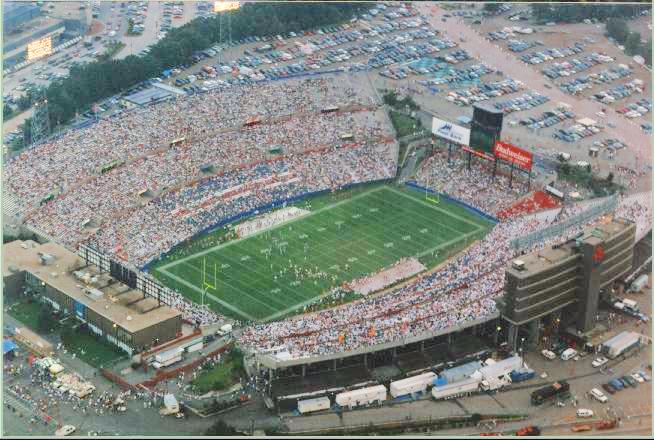
    Sullivan Stadium (Foxboro Stadium), 1 Patriot Place, Foxborough, MA


    Capacity 55,000

    In 1971, Schaeffer Stadium was constructed for a little more than $6 million. The name has changed (twice), but for the past 29 seasons the "home" venue has remained the same.

    William H. "Billy" Sullivan, to ensure the long-term viability of pro football in New England, established one of the nation's first naming-rights agreements in 1970 when he persuaded Schaefer Brewing Co. to put its name on the facility. The price: a whopping $150,000.

    Foxboro Stadium (originally Schaefer Stadium, formerly Sullivan Stadium, commonly Foxborough Stadium) was an outdoor stadium, located in Foxborough, Massachusetts. Although the official spelling of the town's name is "Foxborough", the shorter spelling was used for the stadium.[3]
    The site was selected when the owners of Bay State Raceway donated the land, midway between Boston and Providence, Rhode Island. Ground was broken in September 1970, and it was built in less than 11 months at an announced cost of $4,000,000, (later determined to be about $7.1 million, or $37.5 million in 2007 dollars) a bargain price, even at the time, for a major sports stadium. This was because the Patriots received no funding from the Commonwealth of Massachusetts or the town of Foxborough. Because of this, and also the era in which it was designed and built, it had very few amenities — the type that became commonplace at football stadiums in the 1990s — such as individual seating, "club seats", luxury suites, and deluxe locker rooms for the teams.
    During Kiam's ownership of the Patriots, ESPN anchor Chris Berman humorously referred to the facility as "Shaver Stadium", lampooning Kiam's ownership of Remington Razors.
    When this agreement expired in 1983, Anheuser-Busch took over the rights, but instead of putting the name of one of its brands of beer on the stadium, agreed to name it Sullivan Stadium in honor of the Sullivan family, majority owners of the Patriots. After the family sold their majority interest in the team to Victor Kiam, the stadium was officially renamed "Foxboro Stadium."

    By the late 1990s Foxboro Stadium had become functionally obsolete by modern NFL standards. The facility was built cheaply as a "bare bones" stadium and had very few modern amenities. It also lacked luxury boxes, a major source of revenue for other teams in the league, and most patrons had to sit on backless aluminum benches as only a small fraction of the stadium had actual seats (painted blue, red, and white near the 50-yard line). With a capacity of just over 60,000, it was one of the smallest stadiums in the NFL.
    After 31 NFL seasons, Foxboro Stadium was demolished in January 2002, after the conclusion of the 2001 season (in which the Patriots won their first Super Bowl). The last game played in the stadium—"The Tuck Rule Game"—was played in a snow storm; a Patriots win against the Oakland Raiders, which famously featured an overturned fumble call based on the tuck rule in the final minutes. The stadium's former site became the parking lots of its successor, Gillette Stadium, before being developed into the open-air shopping center Patriot Place.


    Jerry performed here on
    7/4/87 Grateful Dead Bob Dylan (Sullivan Stadium)
    7/2/89 Los Lobos Grateful Dead (Sullivan Stadium)
    7/14/90 Grateful Dead (Foxboro Stadium)


    3.)^http://www.patriots.com/search/index.cfm?ac=searchdetail&pid=3109&pcid=41

    Wednesday, October 10, 2012

    Music Mountain, Avon Lodge, South Fallsburg, NY


    1944 Avon Lodge
    Music Mountain was located at the Avon Lodge in Woodridge. The Village of Woodridge is in the Town of Fallsburg. Raphael Kasofsky and Meyer Arkin were owners of the popular Avon Lodge a mile outside of Woodridge. Arkin's 156 acre Avon Lodge was where Sid Caesar first performed in public. As a member of the hotel's kitchen staff in the 1940s, Sid and others put on socially aware plays and skits in the hotel theater, including works by Clifford Odets.


    Music Mountain was founded by Jacques Gordon, founder and first violinist of the Gordon String Quartet, with the primary mission of education through the performance of the chamber music literature, specifically, the music for the string quartet.
    Jaques Gordon
    In 1930 Mr. Gordon established summer residence in Falls Village, New York. The Gordon Musical Association, established that same year, maintained a summer school of music called Music Mountain, where many students gathered to study repertory and chamber music and to hear performances by the Gordon String Quartet.(4) Mr. Gordon is buried behind Gordon Hall, on the property.

    Don Appel moved his troupe to the Avon Lodge in the summer of 1942 from Kutsher's Country Club in Monticello.(3)

    The concrete bandshell remains although quite decrepit...there is the Navasink River in front of property.(1)

    Nicholas Gordon, was the son of the founder and president of Music Mountain in 1981. The publicisct was Donald Kobler.(5)

    The Allman Brothers played here on August 22, 1981.
    The Beach Boys performed here on September 4, 1981.

    Music Mountain is the nation’s oldest and most distinguished continuing summer chamber music festival. It moved to Falls Village , CT sometime after 1982.

    The property is for sale.


    Jerry performed here on
    6/16/82 Jerry Garcia Band


    1.)^Miller, Scott, Scottshredder@gmail.com
    2.)^Grine Felder, http://www.columbia.edu/~lnp3/mydocs/culture/Grine_Felder.htm
    3.)^Caesar, Sid, Caesar's Hours:My Life in Comedy, pg 34
    4.)^Watanabe, Ruth, The Gordon Collection of String Music, vol.7, winter 1952, no. 2
    5.)^Daytona Beach Morning Journal, 81-05-21, Old Group Dropped Abruptly, pg 17a

    Tuesday, October 9, 2012

    Sweetwater, 153 Throckmorton Ave., Mill Valley, CA


    The Sweetwater is the legendary Mill Valley music club which for over 30 years had been the premier live music location in the North Bay.

    The bar is lit with a dim, orange lighting scheme. And it was filled choc-o-bloc with chairs and tables.


    Live musical performances by the likes of Bonnie Raitt, Elvis Costello, The String Cheese Incident, John Lee Hooker, Carlos Santana, plus many others [1]. There were typically at least 4 to 5 musical acts booked per week making it a popular local hangout.[1) The Sweetwater also featured an open mike night on Mondays that had occasionally featured surprise performances by well-known artists such as Gregg Allman, Train and others.
    The band Hot Tuna recorded two live albums at Sweetwater in the early 1990's[3]featuring guest performances by local figures such as Bob Weir and Wavy Gravy.
    BBC Television shot a documentary at the club featuring John Lee Hooker, Bonnie Raitt and Ry Cooder.
    In 2004, the establishment faced eviction by landlords who needed to raise the rent to more than what the owners claimed they could pay.Through donations the bar was saved and its lease was renewed when the owners of the building generously offered new terms. It was not however disputed that the new rent was fair and the owners of the Sweetwater entered into a month to month lease.[1)
    In September 2007 Sweetwater closed because the landlord of the building found it necessary to renovate the somewhat run-down property and declined to offer the club terms for a new lease after the renovation's anticipated completion.[3] The owners of the building were also the long time owners of a very popular Italian restaurant next door that had been established in the 1960's. A spokesman for the family that owned the building and restaurant said at the time that the building would undergo long-overdue repairs and maintenance and that the new Sweetwater owners knew about renovation plans since their lease had expired two years previously. "We've been in this community for 45 years," he said. "If we wanted to throw the Sweetwater out, we would have done it a long time ago."(2)

    In 2012 it's located in the Masonic Hall at 19 Corte Madera Avenue in Mill Valley, the Sweetwater Music Hall offers food, drinks, and a broad spectrum of live music and entertainment


    Jerry performed here on
    4/24/89 Elvis Costello
    12/17/90 David Grisman


    1.)^Selvin, Joel, Sour note at Sweetwater prompts outpouring of support, http://www.sfgate.com/cgi-bin/article.cgi?f=/c/a/2004/03/18/DDGM35LTCQ1.DTL#ixzz1veamIAne, 2004-03-18
    2.)^Selvin, Joel, Longtime club Sweetwater set to close Sept. 1, http://www.sfgate.com/cgi-bin/article.cgi?f=/c/a/2007/08/08/DDEGREBHN.DTL#ixzz1vebKjmDG, 2007-08-09, http://www.sfgate.com/cgi-bin/article.cgi?f=/c/a/2007/08/09/DDEGREBHN.DTL

    Monday, October 8, 2012

    Lodge, Lompico, CA

    The community of Lompico was founded in 1927. The community consisted mostly of cabin homes for summer residents.
    With the 1960's came the hippies and also came the community's two most famous residents. Jerry Garcia and Janis Joplin. Jerry's grandparents lived here, and he was a common visitor. Janis once inhabited an old lodge on the Islandia property.


    It's unknown which lodge this event took place at.


    Jerry performed here in
    Late 1950's Daniel & Tiff Garcia
    "Near the summer house at a lodge in "Lompico" in the wooded part of Northern Santa Cruz County; Daniel, Jerry & Tiff (Jerry's brother) play. They play some Wilbur Harrison tunes up on the lodge dance floor. Jerry & Daniel on guitar and Tiff thinks he was beating on a cymbal & a box by ear and copying records. On other occasions it would be the "Garcia Brothers" with Jerry & Daniel on guitar & Tiff on bass sometimes.(1)

    The Santa Cruz Sentinel ran the following headline: "Jerry Garcia's finger rests in county folklore." When Garcia was 4 years old and staying with his grandparents in Lompico, his brother accidentally chopped off most of Jerry's right middle finger with an ax. A few months later his father was swept away by a river in Northern California.(2)


    1.)^Jackson, Blair, Garcia: An American Life, pg. 23.
    2.)^ O'Sullivan Art, Metro Santa Cruz, 2005-08-3-10,

    Sunday, October 7, 2012

    Music Hall, 270 Tremont Street, Boston, MA

    1928 postcard
     Capacity-3600

    Architect Clarence H. Blackall
    French Rennaisance

    In a 1918 Boston street directory, the site of the Wang Theater (Music Hall)., between the Wilbur Theater and Hollis St., was occupied by the New Richword Hotel.(Ron Salter-cinema treasures)

    Built in 1925, the theater was originally intended to be named Capitol rather than Metropolitan. The building combines a 14-story Renaissance Revival office building of granite and cast stone, with an auditorium seating 4225 people. The interior is characterized by a series of vestibules and lobbies, highly decorated in marble, bronze, ornate gilding, and painted friezes.
    According to Donald C. King's new book The Theatres of Boston: A Stage and Screen History, the Metropolitan opened on October 17, 1925, with 4407 seats. 
    Photo courtesy of Noah Kern

    Photo courtesy of Noah Kern

    The interior, modeled after Garnier's Paris Opera and decorated in the Louis XIV style, was appropriately advertised as "the public castle" with "a thousand and one wonders" including the grand lobby with four tiers of prominades, spacious lounges, marble doorways, rose jasper pillers, tow 1800-lb. gold plated chandeliers, bronze details by the Gorham Company, and $10,000 in gems decorating the central mural painting by Edmund Philo Kellog.(1)
    Photo courtesy of Noah Kern


    The Metropolitan opened on October 17, 1925, with 4407 seats.(2)


    The Metropolitan presented a first-run film, symphony orchestra overture and ballet, followed by vaudeville. It booked famous stars like Amos and Andy, Kate Smith, and Rudy Vallee, whose acts were not completely absorbed by the house's vastness and grandeur. Such huge auditoriums hastened the demise of vaudeville, whose very intimacy had been its greatest attraction.

    'American Theatres of Today' Vol 1 (published in 1927) credits the following as architects of the Metropolitan Theatre;- Blackall, Clapp & Whittemore; C. Howard Crane, Kenneth Franzheim, George Nelson Meserve, Associated architects.(KenRoe-cinema treasures)

    1929 photo courtesy of George Mann
    The initial developer of the Metropolitan was Boston movie mogul Nathan Gordon. The cost was over $8,000,000. The theater employed a corps de ballet, a 100-voice chorus, and a 55-piece orchestra.
    There was a 3100-pipe 4/26 Wurlitzer organ.


    In October 1973, the instrument was not in playing condition. The Metropolitan Theater had been booking rock concerts, and at least at one of those concerts, some overly energetic fans broke into the Solo Chamber, walked through and crushed much of the Orchestral Oboe, Kinura, Krumet, and Solo Strings. Gerry Duffy and the late Dr. Gordon Potter to remove, crate, and have it shipped to Portland in December, 1974.  The four manual console from the Boston Metropolitan Theatre ended up as part of the Oriental Wurkitzer in the Portland Organ Grinder, a restaurant. It's since closed and the organ was sold and then parted out.(14) The console went to Garrett Shanklin of Groton, MA (30 miles west of Boston) for use in his 4/34 Conference Center installation. The 32 foot Diaphones went to Organ Stop Pizza in Mesa, AZ. (4) Bummer.
    1973 damage
     They had forced open some shutter blades and promptly plopped their stoned-asses in the middle of the chest, grooving to some gawd-awful rock band.  The English Post Horn was also missing—but its 16’ octave was still there. The Brass Trumpet had been replaced with a Gottfried French Trumpet. Gerry Duffy and the late Dr. Gordon Potter removed, crated, and had it shipped to Portland in December, 1974.(14)

    Along with the stage shows, the musicians and dancers presented tableaux, ballet, and operatic moments. Admission cost 35 to 75 cents. To amuse people waiting to be seated, there were musicians playing in the Grand Lobby, paintings by area artists hung on the walls, and ping pong and billiards downstairs. After the show, couples danced in the Grand Lounge, and in 1932 a small Art Deco restaurant called the Platinum Salon opened in the lounge area.

    1930
    Resident producer John Murray Anderson arranged his own stage shows.
    A seating board and cadre of 40 well-mannered, costumed ushers made sure that no seat remained empty long.
    There was a screening room in the Met with some 90 seats in it for showing new movies to "the trade". It was located upstairs somewhere at the front of the house. The space is still there, but the mini-cinema is long gone.(7)

    In February 1938, the Metropolitan dropped its stage shows. 

    By the 1940's costs were mounting and big name headliners became increasingly necessary to draw crowds. The Big Bands, including Duke Ellington, the Dorsey Brothers, Benny Goodman, and Gene Krupa, played here. Bob Hope, Al Jolson, and Dorothy Lamour performed at war bond drives. After world War II attendance declined due to the impact of TV. Stage shows were abandoned for a while, but after the Boston Opera House was destroyed in the late 1950's, the theatre became attractive to large touring productions.

    The Film Daily Yearbook 1941 gives a seating capacity of 4,330, by 1950 it was listed as 4,100 seats in the F.D.Y.(Ken Roe-cinema treasures)
    1947
    1959
    The attendance record at the Metropolitan was broken in the early fifties when Dean Martin & Jerry Lewis were booked live on stage for a week. The shows were continuous every day and featured Les Brown & his Orchestra, Helen O'Connell and Gene Sheldon. The crowds were almost uncontrollable. There is a secret door leading from the dressing rooms directly into the downstairs Mens' Lounge. This is how Martin & Lewis escaped the mobs at the Stage Door. They simply mingled with the patrons walking out of the Lounge and out into the street.(Chet Dowling-cinema treasures)

    According to an unpublished draft manuscript by Douglas Shand-Tucci entitled The Puritan Muse (available in the Fine Arts room of the Boston Public Library), the last show as the Metropolitan was on May 31, 1962.

    Over the years it moved from the M&P chain to ATC to New England Theaters, and finally to Sack.(Ron Newman-cinema treasures)

    The Metropolitan was acquired by the Ben Sack chain and reopened on July 13, 1962 as the Music Hall with "Boys Night Out" with James Garner and Kim Novak. Brad Roberts-cinema treasures)

    During Sack's operation, the Music Hall presented occasional road stage productions, opera, and ballet, as well as movies.(Ron Newman-cinematreasures)
    The theatre hosted such groups as the Bolshoi Ballet, the Boston Ballet, and the Metropolitan Opera. However, stage depth and production facilities were inadequate, and many touring shows were forced to bypass the Boston audience.
    At that time in 1962 Sack was bringing nostalgia back to the theater, had installed huge bright red velvet curtains, and the movies were preceded by 'Louie Wier at the Mighty Wurlitzer'-the huge pipe organ rose on an elevator from the pit, an ancient Louie played things like the 'Skaters Waltz' with a spotlight on him, then sank back into the pit. All that heaven camp in 1962. He used to have Italian tenors occasionally perform between films also.

    Ben Sack guaranteed 20th Century Fox $200,000 to obtain "Cleopatra" for the Music Hall, a fortune of money in those days. In advertising the film, a big deal was made over the fact that all seats were in the orchestra; but Sack and his manager A. Alan Friedberg - who later ousted Sack from his own company - notoriously sold "strip tickets" in the balcony on weekends when demand was high. These tickets were very unlikely reported in the ticket manifest that went to Fox, helping Sack get a quicker return on his "guarantee."(Bill Liberman-cinema treasures)

    The world premiere of "Torn Curtain" which Hitchcock scheduled for 9AM on a Wednesday morning, to cut a 50 layer cake for his 50th film (not surprisingly, Newman and Andrews did not attend). (Brad Roberts-cinema treasures)

    By the late 60's rock concerts started up there and it was a perfect venue to see great rock acts before the era of stadium rock. Some of the great concerts  there were Jefferson Airplane (a few times), Neil Young (an all acoustic set in 1970), Joni Mitchell, The Moody Blues, Linda Ronstadt and more.(Brad Roberts-cinematreasures)

    In 1974 the Boston Redevelopment Authority identified the Music Hall as a theatre with potential to serve the city and suggested to the owners, the New England Medical Center Hospital, that a non-profit group by established to lease and renovate the facility. Metroplitan Center, Inc. was incorporated in 1976.
    The Boston Globe and Herald archives, I see that the theatre officially changed over from Sack Theatres' Music Hall to the Metropolitan Center on July 7, 1980.(Ron Newman-cinema treasures)

    In 1983 the roof was seriously damaged, and the theatre was about to be demolished. A plea went out to the community to save the theatre, and Dr. An Wang of computer fame answered the plea with a gift of $4,000,000. The theatre was renamed in his honor. The(Ron Newman-cinema treasures)

    For the record, it's probably worth clarifying that the Music Hall was renamed The Metropolitan Center in the 1970's, then (as noted in a previous post) renamed The Wang Center following Dr. Wang's donation in the mid-1980s. (7)

    And on February 22, 1991 (a Friday night) it squeezed in a special showing of Ben-Hur with Charlton Heston sitting in the audience. he stayed for the entire film, although the 70mm print was a blown up, cropped version of the original Cinemascope film.(Dan Petitpas.cinematreasures)
    A shame that the Wang isn't viable as a film house, because it is far from ideal as a venue for live theater. While the large seating capacity---more than twice the size of a typical Broadway house---means a high gross potential, the acoustics and sightlines are mediocre and charging near-Broadway prices for the rear orchestra and mezzanine makes little sense due to the considerable distance from the stage (bring binoculars).(7)

    The Wang Theatre (formerly the Metropolitan Theatre), along with the Shubert Theatre, the two theatres operated by the non-profit Wang Center for the Performing Arts has been converted into a grandiose performing arts center that, until spring of 2005, delighted movie audiences with ocasional showings of classic films.


    Conrad Schmitt Studios restored the elegant decoration, gilded moldings, murals, scagliola and marbleized surfaces of the Renaissance Revival and Baroque style theatre, which is one of the largest historic theatres in New England. Prior to the restoration, layers of dirt and darkened varnish muted the splendor of the original finishes. Entire murals were missing. Other pieces clung to the ceiling.
    An investigation of the original colors and finishes was conducted by CSS as a guide for the restoration work. To commence the project, years of accumulated dirt was lifted from the surface of the four-story lobby, followed by the application of paint, gold and aluminum leaf and tinted varnishes. The newly restored lobby then served as a large-scale visual sample to encourage donations for the restoration of the entire theatre. Two teams of artists and decorators worked around the clock to complete the restoration of the 3,600-seat main house in just 18 weeks.
    A theater whose beauty is really the 'big' thing, the Wang Theatre has state-of-the-art sound technology along with beautiful decorations and gold plated figures. It also features a large stage, with the auditorium containing a 1,500 seat balcony, a mezzanine, and 20 box seats along its edge.

    There were, and still are, two brass-doored elevators to take people up to the top of the balcony. They were the old kind that required an elevator operator.

    It is still possible to go from the lobby to back stage by way of a passageway in the basement which leads from the lounges at the lower level to the basement under the stage.(4)

    Irregularly-shaped Renaissance Revival "palazzo skyscraper" with symetrical, 11-bay Tremont facade. Two-story colonnade of engaged fluted Greek Ionic columns at level 2-3. Shaft of building organized by rising piers, recessed spandrals and paired metal window units, with ornament concentrated at level 4 and 5. Building terminated by two-story colonnade of engaged Corinthian pilasters at level 12 and 13, plus denti cornice and roof cresting of palmettes and theatre masks.

    The Music Hall/Metropolitan is highly significant as the largest theatre in Boston history and one of the largest in the country, as the best example of the sumptuous "movie palace" of the roaring twenties and as the last of Clarence Blackall's 14 Boston theatres.

    The theatre reputedly cost 8.5 million, seats 4200-4400, and is housed in a large office building, first to be constructed in Boston under a new height limit of 14 stories.

    The Orpheum and the old Music Hall are four blocks apart.(15)


    Jerry performed here on
    4/7/71 New Riders Of The Purple Sage and Grateful Dead
    4/8/71 New Riders Of The Purple Sage(3) and Grateful Dead
    12/1/71 Grateful Dead
    12/2/71 Grateful Dead
    9/15/72 Grateful Dead
    9/16/72 Grateful Dead
    11/30/73 Grateful Dead
    12/1/73 Grateful Dead
    12/2/73 Grateful Dead
    6/9/76 Grateful Dead
    6/10/76 Grateful Dead
    6/11/76 Grateful Dead
    6/12/76 Grateful Dead
    3/14/78 Jerry Garcia Band
    11/13/78 Grateful Dead
    11/14/78 Grateful Dead(2)


    1.)^Boston Theatre District: A Walking Tour", Boston Preservation Alliance, 1993.
    2.)^http://www.deadlists.com/default.asp
    3.)^http://www.nrpsmusic.com/music/1971.html
    4.)^Salter, Ron, 2011-11-08, http://cinematreasures.org/theaters/29
    5.)^Andy, comments, http://cinematreasures.org/theaters/29
    6.)^Newman, Ron, comments, 2008-09-26, http://cinematreasures.org/comments?page=2&theater_id=29
    7.)^EricH, comments, 2005-01-04, http://cinematreasures.org/comments?page=5&theater_id=29
    8.)^danpepitas, comments, 2008-08-28, http://cinematreasures.org/comments?page=2&theater_id=29
    9.)^Borisbadenov, comments, 2004-12-25, http://cinematreasures.org/comments?page=6&theater_id=29
    10.^KenRoe, comments, 2004-11-02, http://cinematreasures.org/comments?page=6&theater_id=29
    11.)^BraqdRoberts, comments, 2002-05-13, http://cinematreasures.org/comments?page=6&theater_id=29
    12.)^bliberman, comments, 2008-09-22, http://cinematreasures.org/comments?page=2&theater_id=29
    13.)^King, Donald, The Theatres of Boston: A Stage and Screen History
    14.)^Hedberg, David, Theater Organ, American Theatre Organ Society, Inc.
    15.)^Keenan, Walter, Garcia historian.

    Saturday, October 6, 2012

    (Seashore) Performing Arts Center, Turn Road, Old Orchard Beach, ME


    Capacity 15000


    Built in 1985 and formerly known as the Ballpark, SEAPAC was booked by Providence's Frank Russo from 1989 to 1991.

    The 48.7 acres of land The Ballpark sits on today, and approximately 100 acres that surround The Ballpark lot, was purchased by the town in the 1970’s. The town used some of the land to build the police and fire stations and the schools. After construction of the facilities was completed, lots of open space remained. In 1983, the town decided to sell about 50 acres to Jordan Kobritz so he could build a park for his professional baseball team. In order to secure financing for the project, the town agreed to co-sign the loan with Mr. Kobritz. After three seasons of baseball, Mr. Kobritz sold the team and left town. Old Orchard Beach was required to pay back the 2.2 million dollar loan. The town would reacquire the land after paying off the debt.

    In 1989, the town decided to help pay back the money it owed by leasing the ballpark to the Seashore Performing Arts Center (SeaPAC). SeaPAC was run by Dale Blow and Frank Russo. For three years, from 1989 to 1991, Mr. Blow and Mr. Russo mostly used the venue for music shows. An up and down relationship with the town and complaints from citizens about traffic and noise caused the relationship between the town and SeaPAC to end.

    In 1993 a new business, Ballpark Productions, owned by Old Orchard Beach native Archie St. Hilaire, entered into an agreement with the town to produce concerts and family-oriented events at The Ballpark. The town leased the venue to Ballpark Productions from April to October in the years 1994, 1995, 1996, and 1997. Mr. St. Hilaire chose not to renew the lease after 1997. Shortly after Ballpark Productions stopped producing events, Ed Anderson leased The Ballpark for three years because he wanted to bring a professional soccer team to town. He never did and the facility has not been used since.(1)

    “The Ballpark” which used to be the home of the class AAA Maine Guides (Philadelphia Phillies, Cleveland Indians). In recent years, the Ballpark underwent major renovations after sitting idle for nearly a decade. The entirety of the renovations were possible only through the volunteer work, donations, and determination of the local community.(2)


    Jerry performed here on
    9/13/89 Jerry Garcia Band


    1.)^The Old Orchard Beach Ballpark, http://www.oldorchardbeachballpark.com/HistoryUpTo2003.html
    2.)^Futures League Adds Old Orchard Beach, ME, http://www.oldorchardbeachballpark.com/index.html

    Friday, October 5, 2012

    Rehearsal Space, Novato, CA

    "We moved to Novato where the Dead had their office and rehearsal space in what was affectionately known as "The Pink behind Pinky's". The building was the color of Pepto-Bismol and was located down a long driveway behind Pinky's Pizza Parlor. We shared a fence with Hamilton Air Force Base."(1) In 2012, Pinky's Pizza Parlour is located at 321 Petaluma Blvd So., Petaluma, CA.


    Jerry rehearsed here on
    1/13/69 Grateful Dead  Fleetwood Mac
    Stuart "Dinky" Dawson's narrative makes it plain that the day of the jam between the Grateful Dead and Fleetwood Mac is Monday, January 13, 1969. Dawson:
    Later that same day [Monday], we drove over the Golden Gate Bridge to Sausalito [sic], where we had been invited to hang out at the Grateful Dead's rehearsal space. I finally met Owsley and bonded with the group's sound engineer, Dan Healy, and Ramrod, the stage manager. They had set up all the Dead's equipment and soon the informal session got into full swing.
    It's clear to me that Fleetwood Mac went to Novato, where the Dead rehearsed, not Sausalito. Dawson was an Englishman on his first trip to America, so it's no surprise that he wasn't clear about Marin suburbs--I wouldn't know the difference between, say, Staines and Woking, were I south of London, particularly a few decades after the fact. Dawson's most interesting comment follows(3):
    Watching Jerry Garcia and Peter [Green] get off on each other and trade bluesy licks amazed me. Ron McKernan, also known as Pigpen, the Dead's fearsome looking but lovable keyboard player, held things together with his fantastic rhythmic piano playing.(2)(3)


    1.)^Wickersham, Susan, Alembic History, http://www.alembic.com/family/history.html
    2.)^ Dawson, Stuart "Dinky", Life On The Road, pg. 74.
    3.)^http://hooterollin.blogspot.com/2012/02/january-13-1969-rehearsal-space-novato.html

    Thursday, October 4, 2012

    Mosque, 6 North Laurel Street and Main, Richmond, VA


    Capacity 4600

    Built in 1926 by the Shriners as their Acca Temple Shrine.
    Completed at a cost of $1.65 million, the theater boasts the largest proscenium arch stage on the East Coast. It was designed in 1925, in Moorish Revival style(5), by Marcellus Wright, Sr. in association with Charles M. Robinson and Charles Custer Robinson.  Though it opened in October of 1927 it was officially dedicated on January 9, 1928.


    The building is a lavish replica of a Moslem Temple. Twin minarets and a tall arch mark the entrance while corners have small domes. Glazed terra cotta ornament is used throughout. 75,000 square feet of gold leaf went into the dome alone, and another 35,000 square feet of aluminum leaf was used.

    The Auditorium decorations include Saracenic decorations and five paintings bordering the proscenium arch of the stage. Ornamental tile used in the interior was imported from Spain, Italy and Tunis, along with lush carpets, silken curtains and paintings.


    Ceiling tile

    Besides the auditorium, the building contains 24,300 square feet of office space, an 18,000 square foot ballroom and a 20 by 70 foot swimming pool.

    Some of America’s greatest entertainers have appeared on its stage.
    Through the 1930's the Mosque Theater played host to films, concerts and a plethora of entertainers and theatrical productions which included the Ziegfield Follies, Ethel Barrymore, Maude Adams, George Gershwin and Sergei Rachmaninoff, to name but a few.

    In 1935 the Acca Temple was financially strapped and forfeited the mortgage on the Mosque to the New York Life Insurance Co.

    In 1940 it was purchased by the city of Richmond for $200,000.00, $375,000 less than New York Life’s asking price in 1939.

    In 1941 the Tommy Dorsey Orchestra performed there with a new young vocalist, Frank Sinatra.


    Shirley Maclaine and her brother Warren Beatty grew up in Richmond. Shirley Maclaine danced on stage at the Mosque at four years old. Her stories are recounted in "Songlines of Richmond."


    June 30, 1956 at The Mosque, photo courtesy of Jerry Osbourne
    In late January of 1952, more than three years before Elvis, another Louisiana Hayride alumni had a short run there. Hank Williams, barely a month after his back surgery and assets frozen pending his divorce from his first wife was in Richmond for his first big show of the last year of his life. Horace Logan wrote, it was a total catastrophe. His back was still killing him, and he was so full of pills and booze that he couldn't remember the words to his own songs. The crowd booed and jeered at him, and a writer for the Richmond Times-Dispatch gave him a scorching review. The next night, he stormed to the microphone at Richmond's Mosque Theatre and dedicated his first song-- “Mind Your Own Business”—to a "certain lady writer that you all know." It earned him a laugh and got the crowd off his back. At least Hank still had a sense of humor.(1)

    The remainder of the ‘50's saw acts at the Mosque that included Sarah Vaughan, Count Basie, Fats Domino, LaVern Baker, Clyde McPhatter, Frankie Lymon, Chuck Berry, the Everly Brothers, Buddy Holly, Paul Anka and Eddie Cochran.
    Dick Dale played with Lawrence Welk!

    In July of 1968 The Who performed and Pete Townshend smashed his custom colored Fender Jazzmaster guitar during the performance.

    "First when I took Jimi Hendrix to check in where I had his reservation, the Jefferson Hotel, an old time fine Richmond hotel near the Mosque, they would not admit him. They took one look and said no way, and I had to take him somewhere else. You could still do that in that day. Secondly, when I went back to check on him prior to the first show, it was my impression that he was so stoned that he likely could not go on. I could not have been more mistaken. He was outstanding, both shows, just as good as you have heard he was for all these years."(3)
    October 11, 1970, Springsteen's band "Steel Mill"

    On March 6, 1994, 43 years after his debut there, Frank Sinatra, at 78, returned and collapsed before a packed house.  Witnesses said he collapsed about two hours after the concert began, was sitting on a stool, singing the last chorus of "My Way," when he suddenly stopped.  "In a real clear voice, he said, 'Get me a chair, ' "then he fell to the floor. When they brought a wheelchair, everybody clapped, because they didn't seem to need a stretcher."  Frank gave his final performance almost a year later, in California.

    On July 31, 1994, the city of Richmond closed the building and refurbished it between 1994 and 1995. In 1995 the name was officially changed from The Mosque to Landmark Theater.[5] It is currently a very popular venue, hosting a number of big-name musical and theatrical performers each year.


    Jerry performed here on
    5/25/77 Grateful Dead
    6/22/82 Jerry Garcia Band


    1.)^Logan, Horace and Sloan, Bill, Elvis, Hank, and Me: Making Musical History on the Louisiana Hayride.
    2.)^ The Ron Brandon Collection at REEL TOP 40 RADIO REPOSITORY
    3.)^ Ron Brandon, http://www.scottymoore.net/mosque.html
    4.)^http://scottymoore.net/mosque.html
    5.)^Daily Press, 1997-04-14, http://articles.dailypress.com/1997-04-14/features/9704140085_1_mosque-parks-foundation-civic-center

    Wednesday, October 3, 2012

    Comedia Repertory Theater, Homer and High Streets (Emerson & Hamilton), Palo Alto, CA

    Possibly the Comedia Theater, corner of Homer and High, now, in 2012, it's a Peet's Coffee.

    Note the address.
    Garcia had a job of sorts doing the lighting at a Palo Alto theater group called Commedia Del Arte, around 1962. Possibly on Emerson Street (possibly on the site of the Aquarius Theater).(1)

    In March 1961, per Dennis McNally, "Garcia volunteered as a lighting technician for a production of Damn Yankees." This sounds like it was an informal deal for a friend, and Garcia seems not to have had any involvement in theater afterwards.
    Dead.net has a new "Celebrating Jerry" clip that's a little conversation with Jerry from 1974. He talks a little about his pre-Dead days:
    "I’d scuffle, I’d hustle, I’d scam. I didn’t want to work, I didn’t want to have a job, didn’t want to live that life, and I didn’t care what I did in order to not have to do it... I never felt pressed by that. I’d sleep in the bus depot, theater lobbies behind the ticket booth. I didn't give a fuck - I got into all those trips, because I didn’t want to make myself into somebody..."
    Aside from being quite a statement of Jerry's philosophy in itself, this opens up the possibility that Jerry was volunteering as lighting tech at a theater in 1961 in return for being able to sleep there!
    We know that at that point, Jerry was living in his car - so sleeping in a theater lobby would actually have been a step up in comfort. When he met Hunter, the two of them would hang out in his car in a parking lot, eating purloined pineapple from tin cans....
    It's not often realized just how down & out Jerry was in that post-Army period, but he often remembered those days with fondness.(2)


    Jerry rehearsed here on
    03/??/61 Robert Hunter
    Jerry meets 19 year old Robert Hunter while working an evening lighting job at the Comedia Theater.(3)


    1.)^http://hooterollin.blogspot.com/2011/07/warlocks-resumes-1965-pre-grateful-dead.html
    2.)^lightintoashes, 2011-07-24, http://hooterollin.blogspot.com/2011/07/warlocks-resumes-1965-pre-grateful-dead.html
    3.)^Jackson, Blair, Garcia: An American Life, pg. 34.

    Tuesday, October 2, 2012

    Tresidder Memorial Union, Stanford University, Palo Alto, CA

    Tresidder Memorial Union is the primary meeting and resource center for Stanford and the surrounding community. Tresidder features a variety of services, ranging from event facilities to a student-run store. The facility is available until 2am each day and is open every day of the year, except University holidays.

    There were periodic concerts at Tresidder Deck. The Butterfield Blues Band played there in January of 1966, and the Lovin' Spoonful performed there right before or right after the Grateful Dead.(4)


    Jerry performed here on
    10/14/66 Grateful Dead
    "The Dead, which had its roots in Palo Alto, first played on campus in 1966 on the back deck of Tresidder."(1)
    "The Grateful Dead played a show on the "roof" on top of Tressider Bowling alley."(2)

    "Their show, held at the Tresidder Memorial Union, had an admission cost of $1.25. The location was identified on the ad as the TMU Deck, which I believe corresponds to the union’s back patio, where classical and jazz concerts are held today."(3)


    1.)^ Maisel, Ivan, class of 1981, a place in the sun, http://www.stanfordalumni.org/news/magazine/2011/mayjun/features/frost.html
    2.)^ S., Eric, 2008-05-23, http://www.paloaltoonline.com/square/index.php?i=3&t=551#add_comments
    3.)^http://cryptdev.blogspot.com/2010/09/airplane-and-dead-at-stanford-66-67.html
    4.)^Arnold, Corry, comments, 2012-10-02, http://jerrygarciasbrokendownpalaces.blogspot.com/2012/10/tresidder-memorial-union-stanford.html

    Monday, October 1, 2012

    Music Hall (Municipal Auditorium), 301 W. 13th, Kansas City, MO


    Municipal Auditorium is a large, multi-purpose facility in Kansas City, Missouri with three halls: The Arena, Music Hall, and Little Theatre.

    The Kansas City Music Hall is a large proscenium theatre opened in 1936 and features Streamline Moderne and Art Deco architecture and architectural details.

     The streamline moderne architecture was designed by the lead architectural firm of Gentry, Voskamp & Neville to appeal to new visitors with cool and confident restraint. True to its name, the style promised to envelop the visitor in modernity, assuring him/her that Kansas City was a rising star in the country, a place to recommend to friends and colleagues.

    Alonzo H. Gentry, of the lead architectural firm of Gentry, Voskamp & Neville, was to later design the Truman Library. Hoit, Price & Barnes, the associated architects responsible for the HVAC work at the Municipal Auditorium, had recently designed the Art Deco skyscraper, the Kansas City Power and Light Building (completed in 1931).
    When the building opened in 1935, it was called by the Architectural Record "one of the 10 best buildings of the world that year". [1]

    The foyer is a splendid display of marble on both floor and walls. Murals adorn the entire theater, and you’ll have to travel a long way to see crystal chandeliers as gorgeous as those adorning the Music Hall. It evokes a sense of grandeur with its high ceiling, marble flooring, and grand staircase and
    eats an audience of 2,400 patrons. The hall presents touring Broadway shows, as well as visiting symphony orchestras, opera and ballet companies, and other events. It was the main hall of the Kansas City Philharmonic for several decades. And when was the last time you saw an actual orchestra pit or had seats in a theater that featured a pipe organ of over 2,000 tubes and constructed with ivory and gold? That's the 1927 Robert-Morton Theatre Pipe Organ that originally was in the Kansas City Midland Theatre. The organ is owned and maintained by Kansas City Theatre Pipe Organ, Inc.[9]

    In 2000, the Princeton Architectural Press called it one of the 500 most important architectural works in the United States.[1]


    Jerry performed here on
    3/26/76 Jerry Garcia Band (Music Hall)
    8/17/80 Grateful Dead (Arena)
    7/7/81 Grateful Dead (Arena)


    1.)^Alonzo H. Gentry, Architect, Is Dead, Kansas City Times, February 7, 1967
    2.)^Kidder G.E. Smith (2000), Source Book of American Architecture, Princeton Architectural Press
    9.)^http://www.kc-theatreorgan.org/